The Complete Guide to Early Morning Hot Pilates
Quick Answer: An early morning hot class is harder than the same class in the evening for reasons that are physiological rather than motivational. Core body temperature is at its daily minimum in the early morning, muscles and connective tissue are genuinely stiffer, you arrive dehydrated after 7 to 8 hours without fluid, glycogen is lower after an overnight fast, and grip strength and peak power measurably lower at that time of day. None of that makes morning hot pilates a bad idea - the adherence benefits are real - but it means hydration must start the night before, the warm-up needs to be longer, and you should expect a different class experience rather than judging yourself against your evening performance.
You booked the 6am because it is the only class that survives your schedule, and it is objectively harder than the 6pm you used to take.
Here is everything that actually differs, and how to set the morning up so the class is worth taking.

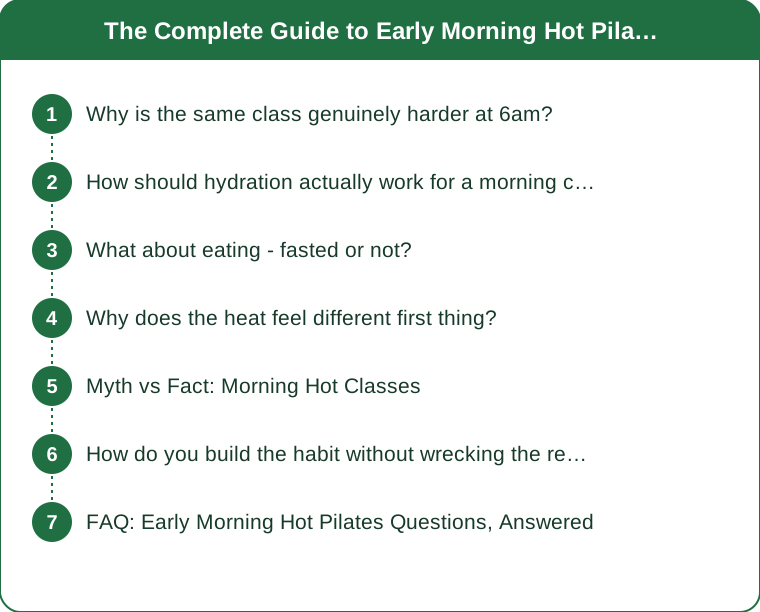
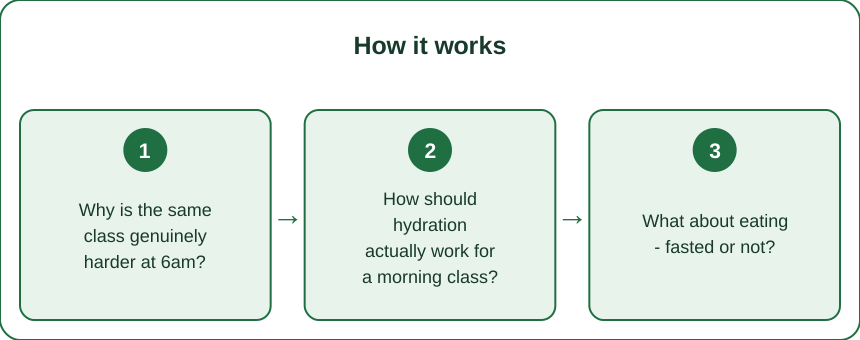
Why is the same class genuinely harder at 6am?
Because almost every physiological variable that matters is at its worst point in the daily cycle.
Core body temperature follows a strong circadian rhythm, reaching its minimum in the early hours - typically an hour or two before habitual waking - and peaking in the late afternoon or early evening. That difference across the day is around 0.5 to 1.0C, and it is not a small thing for exercise performance.
Lower core temperature means higher muscle and connective tissue viscosity, slower nerve conduction, reduced enzyme activity and lower joint range of motion. The practical result is that you are genuinely stiffer, genuinely slightly weaker, and your body takes longer to reach a working state.
Peak power, grip strength and flexibility are all consistently lower in the morning across the exercise physiology literature. Estimates vary but the direction is not in dispute.
On top of that, you arrive dehydrated. Seven to eight hours without fluid intake, plus respiratory and insensible losses overnight, means most people wake down a meaningful fraction of body mass in fluid. Walking into a heated room in that state is a real disadvantage - you are starting the session at the hydration level you would normally reach halfway through it.
And glycogen is lower after the overnight fast, particularly liver glycogen, which matters for maintaining blood glucose during a demanding class.
None of this means you should not go. It means the morning class needs different preparation, and comparing your 6am performance to your old 6pm performance is comparing two different tests.
How should hydration actually work for a morning class?
It starts the evening before, and the morning window is too short to fix a deficit.
The common mistake is drinking a large volume in the twenty minutes before class. That does not hydrate you in time - fluid needs time to be absorbed and distributed, and a large bolus immediately before exercise mostly results in a sloshing stomach and an early bathroom trip.
The structure that works: normal hydration through the previous day, a glass of water with electrolytes in the evening, and then 300 to 500ml on waking, at least 45 to 60 minutes before class where the schedule allows.
Electrolytes matter more in the morning than the evening, because you are starting from a deficit rather than topping up. Sodium is the one that actually matters for fluid retention and for replacing what you will lose in a heated room. Plain water in large volumes on an empty stomach can pass through faster than it is absorbed.
Check the simple markers. First morning urine is normally concentrated and darker regardless of hydration status, so it is a poor indicator. The second void of the morning is much more informative.
During class, sip rather than gulp. In a heated room, sweat rates are high, but drinking large volumes mid-class alongside abdominal work is uncomfortable and can cause nausea.
And rehydrate properly afterward, because the rest of your day proceeds from that state. A common pattern is a well-hydrated class followed by a dehydrated working day, and the fatigue that produces gets blamed on the class.
What about eating - fasted or not?
For most people, something small beats nothing, and the type matters more than the amount.
Training fasted is not harmful for a class of this length, and some people genuinely prefer it - no digestive discomfort, no timing pressure. The argument that fasted training meaningfully improves fat loss is much weaker than it is usually presented; over 24 hours, total energy balance dominates and the timing effect is small.
The practical case against fasted hot pilates is different: lower blood glucose in a heated room increases the likelihood of dizziness and lightheadedness, particularly in the second half of a class with a lot of position changes.
If you eat, keep it small, low fat, low fiber and mostly carbohydrate, 45 to 60 minutes before. Half a banana, a few dates, a small piece of toast, or a sports drink all work. Fat and fiber slow gastric emptying, which is what causes discomfort during flexion-heavy work.
If you cannot eat that early - and many people genuinely cannot at 5am - a carbohydrate drink is the compromise. It empties quickly and it addresses the blood glucose issue without a solid meal.
Caffeine is worth thinking about deliberately. It genuinely improves perceived exertion and performance, and a morning class is where that helps most. But it is a mild diuretic in people not habituated to it, and on an empty stomach in a hot room it can worsen nausea for some people. If you use it, use the dose you are used to, with fluid, and not for the first time on a class morning.
And eat properly afterward. A morning class followed by a skipped breakfast is one of the more reliable ways to have a bad afternoon.

Why does the heat feel different first thing?
Because your thermoregulation is starting from a lower baseline and takes longer to engage.
Sweating is the main cooling mechanism in a heated room, and the sweat response has a threshold and a lag. In the early morning, with core temperature at its minimum, you take longer to start sweating and the onset is at a slightly different point than it would be later in the day.
The practical experience is that the first ten to fifteen minutes feel disproportionately hot and uncomfortable, and then the class becomes manageable once you are properly sweating.
This catches out people who move from an evening class to a morning one, because the pacing they learned in the evening front-loads effort into exactly the window where their cooling is not yet online.
The response is to pace the first quarter deliberately conservatively. Not a lighter class overall - a slower ramp into it.
Room conditions can also genuinely differ. Studios heat rooms in advance, and the first class of the day may be in a room that has just reached temperature - more uniformly hot and often less humid than a room that has hosted three classes and accumulated moisture. Some people find that easier, some find it harder, but it is a real difference rather than perception.
Where you put your mat matters more in the morning. If the studio heats from vents or panels, positioning away from a direct heat source for your first few morning classes gives you more margin while you learn how your body responds at that hour.
Myth vs Fact: Morning Hot Classes
Myth: Morning workouts burn more fat. Fact: Substrate use during the session does shift toward fat when fasted, but total daily energy balance dominates body composition outcomes and the timing effect largely washes out over 24 hours. Train in the morning because it fits your life, not because of this.
Myth: You will be stiff for the whole class. Fact: The stiffness is real but it resolves. Tissue temperature rises within the first ten to fifteen minutes in a heated room, and range of motion by the middle of class is close to your normal. The mistake is attempting your deepest positions in the first quarter.
Myth: The heat compensates for the lack of warm-up. Fact: Only partly. External heat raises skin and superficial tissue temperature much faster than deep muscle temperature, so you can feel warm and be less prepared than you feel. This is one of the more genuinely risky misconceptions in hot classes generally, and it applies most in the morning.
Myth: If you feel dizzy, you just need to push through. Fact: No. Dizziness in a heated room means sit down, get low, and drink. In the morning, with lower blood glucose and higher baseline dehydration, dizziness is more likely and more meaningful than the same symptom in an evening class. This is general information, not medical advice - persistent dizziness, chest symptoms or fainting need medical assessment.
Myth: Morning classes ruin your sleep because you have to wake early. Fact: They shift your schedule, which is different. Morning exercise with light exposure tends to advance circadian rhythm and improve sleep quality for most people - provided you actually move bedtime earlier rather than losing an hour of sleep.
How do you build the habit without wrecking the rest of your day?
Move bedtime first, prepare the night before, and start with two classes a week.
Sleep is the thing that decides whether this works. Adding a 6am class without moving bedtime earlier is just sleep deprivation with extra steps, and the performance and recovery cost of that will outweigh anything the class gives you. Shift bedtime before you shift wake time, by about a week.
Prepare everything the night before: mat, towels, water, clothes, and what you will eat. The morning decision budget is the scarce resource, and every choice you remove increases the chance you actually go.
Two classes a week to start. Morning hot classes are a substantial change in both schedule and physiological demand. Adding four at once is the standard route to abandoning it in a fortnight.
Get daylight after class where you can. It reinforces the circadian shift that makes early waking sustainable, and after a heated indoor class in autumn darkness, ten minutes of morning light is genuinely useful.
Build in a longer post-class window than you think you need. The core temperature elevation after a hot class persists for a while, and going straight into a shower, dressing and commuting can mean sweating through your clothes at your desk. Fifteen minutes of cool-down and cool water before you dress saves the rest of the morning.
And expect four to six weeks before it feels normal. The circadian adaptation to consistent early waking is real but not instant, and most people who quit morning classes do so in weeks two and three - the hardest part of the curve.
This is general information, not medical advice. Anyone pregnant, with cardiovascular conditions, blood pressure issues, or a history of heat intolerance should speak to a clinician before starting hot classes.
FAQ: Early Morning Hot Pilates Questions, Answered
How early should I wake up before a 6am class?
At least 45 minutes if you can, and 60 is better. That gives you time for 300 to 500ml of fluid, something small to eat if you eat, and enough upright time that you are not walking into a heated room straight from horizontal. Waking at 5:40 for a 6:00 class is the version most people actually do and it is the version most people find hardest.
Will I be less flexible than in an evening class?
Early on, yes - noticeably in the first third. Joint range of motion follows the circadian temperature curve and is measurably lower in the morning. By the middle of a heated class the gap largely closes. The important adjustment is not attempting your deepest positions before you are properly warm, because external heat raises surface temperature faster than deep tissue temperature.
Should I drink coffee before a 6am hot class?
If you already drink it regularly, keep to your usual dose and have it with water. Caffeine reliably lowers perceived exertion, which is useful at 6am. If you do not normally drink it, a hot class on an empty stomach is not the place to experiment - nausea and jitteriness in a heated room are unpleasant and hard to escape mid-class.
Why am I more tired all day after a morning class than an evening one?
Usually one of three things: you shortened your sleep rather than shifting it, you did not rehydrate after class, or you skipped breakfast. All three are fixable and none of them are the class. If you have corrected all three and the fatigue persists after a few weeks, reduce the frequency rather than pushing through - it is a signal about total load, not about willpower.
TL;DR:
- Core temperature is at its daily minimum in the early morning, which makes you genuinely stiffer, slightly weaker and slower to warm.
- You arrive dehydrated after 7 to 8 hours without fluid - hydration starts the night before, not twenty minutes prior.
- Something small and mostly carbohydrate 45 to 60 minutes before reduces the dizziness risk that fasted hot classes carry.
- Sweat onset lags in the morning, so the first fifteen minutes feel disproportionately hot. Pace the opening quarter.
- External heat warms the surface faster than deep tissue - feeling warm is not the same as being warm. Do not force early depth.
- Move bedtime before you move wake time, and start with two classes a week.
- Expect four to six weeks before the early start stops feeling like a cost.
This is general information, not medical advice. The 6am class is not a worse version of the 6pm one - it is a different event that needs its own preparation.
See It in Motion
Seen here: High Waist Yoga Leggings with Inner Pocket — shop it on bubblelime.com
Keep Reading
This article is for general informational and styling purposes only. Fit, sizing, and product availability may vary.