Your First Eight Weeks of Hot Pilates: The Complete Guide
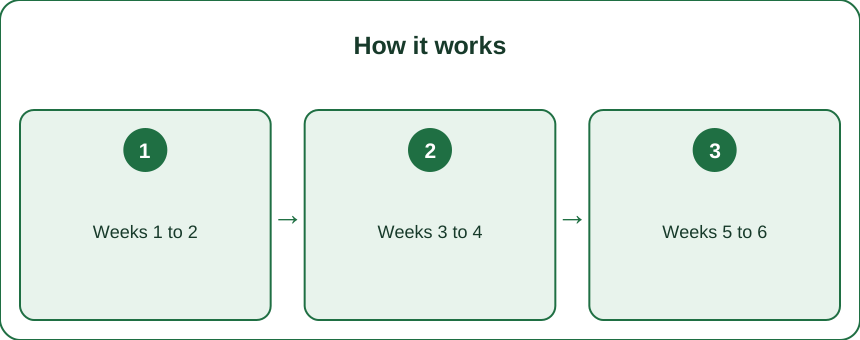
Quick Answer: Heat acclimation takes roughly ten to fourteen sessions and is the single biggest variable in your first two months. Weeks one and two feel disproportionately hard and are mostly about the heat rather than the exercise. Weeks three to four are where acclimation arrives and classes suddenly feel manageable. Weeks five to six are where the actual strength adaptations become noticeable. Weeks seven to eight are where most people either establish a schedule or drift away. Two to three sessions a week is the dose that produces this timeline; once a week does not.
Knowing which week you are in changes how you interpret a bad class.
Weeks 1 to 2: this is a heat problem, not a fitness problem
The first few classes are dominated by a physiological process that has nothing to do with pilates.
Exercising in a hot room raises core temperature faster than in a cool one, and your unacclimated body responds inefficiently. Heart rate runs ten to twenty beats higher at the same workload. Sweating starts late and is composed of higher-sodium sweat, which means you lose more electrolytes for the same fluid loss. Blood volume is at its baseline, so more of your cardiac output has to be diverted to the skin for cooling, leaving less for the working muscles.
The result is that a movement you could do comfortably in a cool room becomes genuinely difficult, and you conclude you are unfit. You may be, but that is not what these two weeks are measuring.
What is normal in this window: feeling wobbly and light-headed toward the end of class, needing to sit out portions, a heart rate that feels disproportionate, an unusual level of fatigue for hours afterwards, and a headache that evening if you did not replace fluid and sodium.
What is not normal and means stop: stopping sweating while still feeling hot, confusion, nausea with chills, or a headache that does not resolve with fluids and rest. Those are heat illness signs and warrant leaving the room and seeking help. This is general information, not medical advice.
What to do differently: take the back row near the door, take breaks without apology, drink 500ml in the two hours before class and add electrolytes rather than plain water afterwards, and go twice in the first week rather than once, because acclimation depends on frequency more than on duration.
And do not judge the studio, the format or yourself in this window. Almost everyone’s assessment of hot pilates after two classes is an assessment of their heat tolerance.
Weeks 3 to 4: acclimation arrives and the class changes
Somewhere between the eighth and fourteenth session, most people experience a distinct shift. It usually happens within a single week and feels sudden.
What has changed physiologically: plasma volume has expanded, typically by five to fifteen percent, which means more blood available for both cooling and working muscle. Sweating starts earlier and at a lower core temperature, so you begin cooling before you overheat. Sweat sodium concentration drops, so you retain more electrolyte for the same fluid loss. And heart rate at a given workload falls, often substantially.
The subjective experience is that the room stops being the problem. You start noticing the exercises, which you may not have registered at all in the first fortnight.
This is also where the first real risk point sits. Feeling suddenly capable, people commonly move to the front row, stop taking breaks, and go from two sessions a week to four. The heat is no longer limiting, but the muscular and connective tissue adaptations have not caught up, and a jump in volume at this point is the most common route to an overuse complaint in weeks five and six.
What to do: hold your frequency steady for another fortnight. Add intensity within the class rather than adding classes. This is the single most useful decision in the eight weeks.
A note on the seasonal effect: acclimation decays. If you start in autumn as the weather cools and then miss two weeks, you will lose a meaningful share of what you built, and returning will feel like week one again. That is expected and it rebuilds faster the second time.
Weeks 5 to 6: the strength adaptations show up
This is where the practice starts paying in the way you hoped it would in week one.
Early strength gains, in the first four to six weeks of any new resistance-based practice, are largely neural: better recruitment, better coordination, better ability to produce force with the muscle you already have. They are real, they are fast, and they are why people who have never done pilates can hold a plank noticeably longer after five weeks without visible change.
In hot pilates specifically, the movements that improve first are the ones with the most technical component: the transitions, the controlled lowering, the single-side work where stability rather than strength was the limit.
What you should notice: holds that were impossible are now merely hard. You can follow the sequence without watching the instructor. Your balance on single-leg work has improved more than your strength has. And you have started to have opinions about which classes and instructors you prefer, which is a reliable sign of moving from surviving to practising.
What you should not expect yet: visible body composition change. Six weeks of two or three sessions a week is not enough to produce that, and expecting it here is the most common reason people quit at week seven.
Where the common overuse complaints appear: wrists, from plank-heavy sequences; necks, from holding the head up in abdominal work; and lower backs, usually from a hip flexor-dominated pattern in leg work. All three are technique-and-volume issues rather than injuries in most cases, and all three respond to modifying rather than pushing through. Persistent pain deserves proper assessment. This is general information, not medical advice.
Add one thing in this window: a non-heated strength or mobility session per week, if you can. It develops the same qualities without the heat cost and accelerates the pilates.
Weeks 7 to 8: the point where it becomes a practice or does not
This is the attrition window, and it is remarkably predictable.
By week seven the novelty has gone, the acclimation improvement has plateaued, and the strength gains have slowed from their initial rate. The class is no longer dramatically better than last week, and there is nothing obviously new happening. This is the normal shape of every adaptation curve and it consistently reads as a plateau.
At the same time, the practical friction that was tolerable during the exciting phase, the laundry, the travel, the timing, the cost, becomes more salient.
What makes people stay:
A fixed schedule rather than a variable one. Same days each week, booked in advance. People who book class by class attend roughly half as often within two months.
A measurable marker that is not appearance. Time in a hold, number of repetitions before form breaks, or a specific movement you could not do. Something that continues improving when the general feeling of improvement stops.
One social connection at the studio. A single person who notices whether you are there is the strongest single predictor of continuing in most exercise settings.
Realistic framing. Anyone expecting visible change in eight weeks will be disappointed in eight weeks. Anyone expecting to be stronger, more mobile and better at handling heat will not be.
What makes people leave: treating a missed week as a failure, comparing themselves to people two years in, and having no plan for the first genuinely bad class after the acclimation phase, which always comes and which is usually about sleep or food rather than about pilates.
Myth vs Fact: Hot Pilates in the First Two Months
Myth: The heat helps you stretch further safely. Fact: heat increases tissue extensibility temporarily, which lets you reach a greater range and does not make that range safer or more permanent. The most common early injury pattern is pushing into a range the heat allowed and the tissue was not prepared for.
Myth: Sweating more means a better workout. Fact: sweat rate reflects heat load and individual physiology, not effort or results. Acclimated people sweat more, earlier, and are working less hard for it.
Myth: You will detox. Fact: sweat is overwhelmingly water and electrolytes. Detoxification is done by the liver and kidneys and is unaffected by how much you sweat.
Myth: If you feel dizzy, push through it. Fact: dizziness in a hot room is a signal to sit down, and continuing is how people faint. Nobody in the room thinks anything of someone sitting out.
Myth: The weight you lose is fat. Fact: it is fluid, and it returns within hours. Weighing before and after class measures dehydration.
Myth: More classes will speed everything up. Fact: heat acclimation responds to frequency, and muscular adaptation responds to recovery. Four classes a week in month one usually produces an overuse complaint rather than faster progress.
Myth: You need special clothing. Fact: you need clothing that does not become heavy when soaked and does not slide on a mat. That is a low bar and most fitted synthetics clear it.
What should the eight weeks actually look like?
Weeks 1 to 2: two classes per week, back row, breaks whenever needed. Hydrate before, electrolytes after. Goal: attend. Nothing else.
Weeks 3 to 4: still two classes per week. Resist the urge to add. Move to the middle of the room if you want. Goal: complete a class without sitting out, once.
Weeks 5 to 6: two or three classes per week, plus one non-heated session. Start paying attention to technique in one specific movement rather than trying to fix everything. Goal: one measurable marker improved.
Weeks 7 to 8: three classes per week if recovery allows, on fixed days. Book them in advance for the whole month. Goal: establish the schedule you intend to keep, and identify one thing you can do now that you could not do in week one.
Throughout, the non-negotiables:
Fluid and sodium. Roughly 500ml before, sips during, and 500 to 750ml with electrolytes after. Plain water alone after a heavy sweat session leaves you with a lower sodium concentration than you started with, which is where the post-class headache comes from.
Food timing. A small carbohydrate-containing meal ninety minutes to two hours before. Training a hot class fasted is a common cause of the light-headedness people attribute to the heat.
Sleep. Heat acclimation is impaired by sleep deprivation, and a bad night reliably produces a bad class. Reading a bad class as a fitness signal when it is a sleep signal is the most common misattribution in the whole eight weeks.
And a decision point at week eight, made deliberately. Is this the format you want? Do you like the studio? Would a non-heated version suit you better? Making that choice explicitly is far better than drifting out of a practice you never decided about.
FAQ: Starting Hot Pilates, Answered
How many classes a week should a beginner do?
Two, for the first four weeks. Heat acclimation needs frequency; muscles need recovery. Two balances both.
How long until it stops feeling awful?
Roughly ten to fourteen sessions for the heat specifically. It is usually a sudden shift rather than a gradual one.
Should I drink during class?
Small sips as needed. The bulk of the replacement should happen before and after, and drinking a large volume mid-class is uncomfortable.
Is hot pilates safe in pregnancy?
Deliberate exposure to high heat is generally not recommended in pregnancy, particularly in the first trimester. This is a question for your doctor or midwife, not for a studio. This is general information, not medical advice.
Why do I feel exhausted for hours afterwards?
Usually incomplete fluid and sodium replacement, plus the genuine metabolic cost of thermoregulation. It improves substantially with acclimation.
Can I do hot pilates if I hate heat?
Acclimation genuinely changes the experience for most people, and if you still dislike it at week four, non-heated pilates delivers the same movement benefits. Disliking heat is a legitimate reason to choose a different format.
When will I see physical changes?
Strength and endurance changes are noticeable by week five or six. Visible composition change takes considerably longer and depends far more on total activity and food than on this class.
TL;DR:
- Weeks 1 to 2 measure your heat tolerance, not your fitness. Back row, breaks, electrolytes, two classes a week.
- Weeks 3 to 4 bring acclimation, usually suddenly. Hold frequency steady rather than doubling it here.
- Weeks 5 to 6 deliver the first real strength gains, which are largely neural and genuinely fast.
- Weeks 7 to 8 are the attrition window: fixed schedule, a non-appearance marker, and one social connection are what keep people.
- Replace sodium, not just water, and do not attend fasted.
- Heat allows greater range without making it safer, which is the main early injury mechanism.
Most people quit during a phase that has a name and a timeline. Knowing which week you are in is most of the battle.
See It in Motion
Seen here: Bootcut Yoga Pants with Side Pockets — shop it on bubblelime.com
Keep Reading
This article is for general informational and styling purposes only. Fit, sizing, and product availability may vary.