The Complete Guide to Hot Pilates When You Wear Contacts or Glasses
Quick Answer: Contacts generally beat glasses in a hot room, but only with preparation: use daily disposables rather than monthlies, put in fresh lenses right before class, blink deliberately during held positions, and carry a spare pair plus glasses in your bag. Glasses fog within the first five minutes and slide continuously; if you must wear them, use a sports strap and an anti-fog wipe, and accept that you will be practising by feel rather than by sight.
Nobody mentions this in the studio intro email.
You get the towel advice, the hydration advice, the do-not-eat-a-large-meal advice. Then you walk into a 95-degree room with glasses on and within four minutes you are looking at the world through a bathroom window.
Or you wear contacts, and forty minutes in, one eye decides it has had enough and simply stops cooperating.
This is a real, common, almost entirely solvable problem, and it deserves a proper guide.

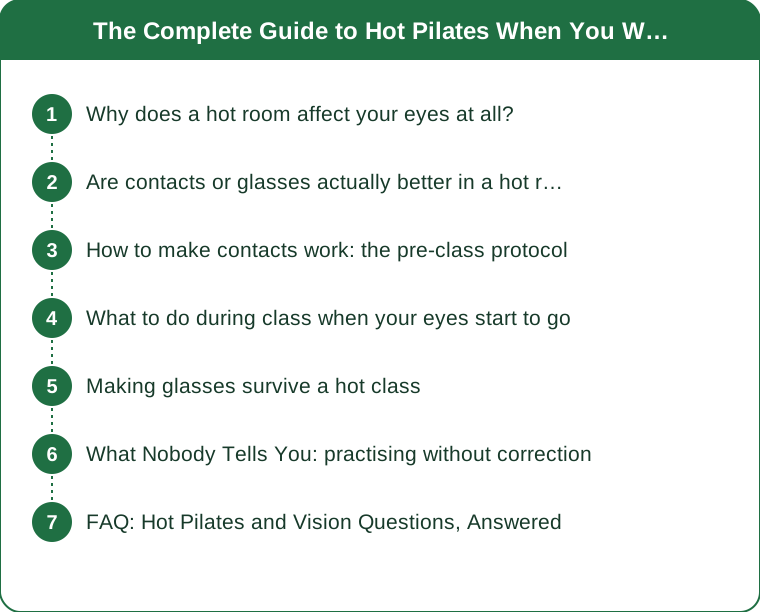
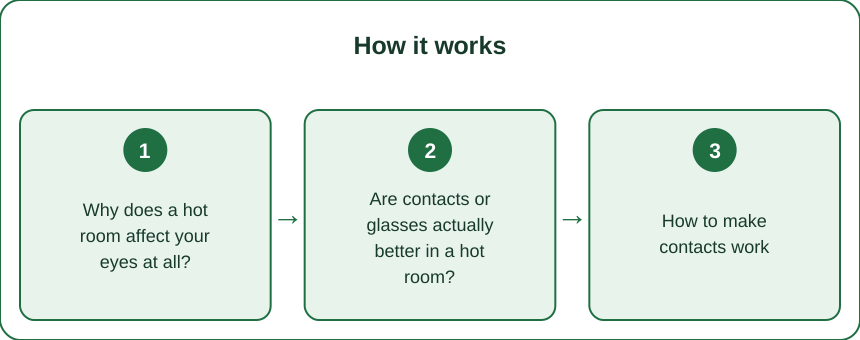
Why does a hot room affect your eyes at all?
Three things happen at once, and they compound.
The tear film evaporates faster. Your eyes are protected by a thin three-layer film — an oily outer layer, a watery middle, a mucus base. Heat thins the oily layer and accelerates evaporation of the watery one. In a room at 90 to 100 degrees, that film breaks up noticeably faster than it does at your desk.
Humidity swings the wrong way for you either way. A dry hot room pulls moisture directly off your eye surface. A humid hot room condenses on every cool surface, which is exactly what a glasses lens is. There is no version of the room that is neutral.
You blink less than you think. In any focused activity your blink rate drops, sometimes by half. In a class where you are holding a position and staring at a fixed point for balance, it drops further. Fewer blinks means the tear film is not being rebuilt, right when it is being destroyed fastest.
Add sweat running into the eye — which is salty, slightly acidic and genuinely irritating — and you have the full picture. This is not sensitivity. This is physics.
Are contacts or glasses actually better in a hot room?
For most people, contacts win, but the margin is smaller than the internet suggests and it depends on which problem bothers you more.
The case for contacts: no fogging, ever. No sliding down your nose during a plank. No worrying about a frame flying off during a dynamic transition. Full peripheral vision, which matters more than people expect for balance work.
The case against contacts: a hot dry room is the single worst environment for lens comfort. Lenses draw moisture from the tear film, and the tear film is already under attack. Soft lenses can dry, stiffen slightly and start to feel like a piece of tape on the eye.
The case for glasses: nothing touches your eye, so no dryness beyond the room’s own effect, and no risk of losing a lens mid-class.
The case against glasses: fogging within minutes, continuous sliding on a sweating nose, and the fact that any position where your head is below your heart turns them into a projectile.
The honest ranking for a hot pilates class: daily disposable contacts, then glasses with a strap, then monthly contacts, then glasses without a strap. Practising with no correction at all is a real fourth option we will come back to.
How to make contacts work: the pre-class protocol
This is the section that actually solves it.
Use daily disposables for hot classes, even if you wear monthlies otherwise. Dailies are thinner, hold more water and, crucially, you throw them away afterwards. Protein and salt deposits from a sweaty ninety-minute session are exactly what makes a monthly lens uncomfortable for the following week.
Insert fresh lenses within 30 minutes of class. A lens you put in at 7 a.m. and wore through a day of screens is already partly dehydrated before you walk in the door. Bring a case and swap in the changing room.
Use preservative-free rewetting drops before class, not during. One drop in each eye about five minutes before you start. Preservative-free matters here because you will be reapplying more often than a normal day and preservatives accumulate.
Do not use redness-relief drops. They constrict blood vessels and can leave your eyes drier and redder afterwards. The bottle you want says lubricating or rewetting, not gets the red out.
Bring the spare kit. A sealed spare pair of dailies, a small bottle of drops, and your glasses. Ninety percent of the time you will not need them. The tenth time you will be extremely glad they are in the bag rather than at home.
What to do during class when your eyes start to go
You will feel it coming: a gritty edge, then blurring that clears for a second when you blink hard, then blurring that does not clear.
Blink deliberately during held positions. This is the highest-value habit in this article. Any time you are in a static hold — plank, bridge, a long series of small pulses — do five slow, full, complete blinks. A full blink means the lids actually meet. Half-blinks, which is what most of us do, do not rebuild the film.
Look down rather than up between exercises. Looking upward exposes more eye surface to the air. A brief downward gaze during a transition covers more of the eye and buys you time.
Never wipe your eyes with the hand you have been using on the mat. Use a clean corner of a small face towel, kept separately from the towel you are lying on. Salt, floor residue and lens surfaces are a bad combination.
If a lens folds or shifts, stop. Sit down at the edge of your mat, close both eyes for twenty seconds, then blink gently and let it settle back into place. Trying to fix a folded lens with sweaty fingers in a dark hot room is how people scratch a cornea. Instructors have seen this before and none of them mind.
If it comes out entirely, do not hunt for it on the floor. It is gone. This is why you brought a spare, and why you can also just finish the class at 20/60 in one eye — pilates does not require precision vision.
Making glasses survive a hot class
If contacts are not an option — dry eye conditions, corneal issues, or simply not wanting them — glasses can work with three adjustments.
Get a sports strap. A neoprene or silicone retainer that hooks over the arms and around the back of the head. It costs almost nothing and it removes the entire sliding problem. This is not optional in a hot room; it is the whole solution.
Use an anti-fog treatment, not a household hack. Anti-fog wipes or sprays made for lenses leave a surfactant layer that stops droplets forming into a haze. Apply before class, not during. Skip the toothpaste and shaving foam tricks on any lens with a coating — they strip it.
Position matters more than you think. Glasses fog worst when warm humid air from your own breath rises past them. In positions where your head is neutral or slightly down, that airflow goes elsewhere. Sitting up straight and tilting the chin down a few degrees during held positions genuinely reduces fogging.
Accept the tradeoff on inversions. Any position where your head goes below your heart, your glasses are going to move. Either take them off for those specific sequences and put them beside your mat, or choose a modification that keeps your head higher. Both are completely reasonable.
What Nobody Tells You: practising without correction
Here is the option almost nobody offers, and it is the one a surprising number of regulars quietly land on.
You can do the entire class without seeing clearly. Pilates is proprioceptive. You are following verbal cues, feeling the position, and using your own body sense to find alignment. The visual input is helpful, not essential, and for most sequences you already know what the shape feels like.
The balance question is real but smaller than expected. Balance uses three inputs: vision, the inner ear, and proprioception. Removing sharp vision does make single-leg work harder. It also makes it a better training stimulus, which is why balance drills are often deliberately done with eyes closed.
The practical version: if your prescription is mild to moderate, try one class with nothing. Put your mat where you can see the instructor as a shape and follow the cues. Many people find the class becomes more internal and less comparative, which is a genuine bonus in a mirrored room.
When this does not work: strong prescriptions, significant astigmatism, or any class where you need to read a spring setting or a screen. Then go back to the contact protocol above.
The compromise a lot of regulars use: contacts for classes with new choreography or a new instructor, nothing at all for the familiar Tuesday class they have done sixty times.
FAQ: Hot Pilates and Vision Questions, Answered
Can the heat actually damage my contact lenses?
Not at the temperatures a studio runs. What it does is dehydrate them, which changes the fit and the comfort. The lens returns to normal after removal; the discomfort during class is the real cost, and dailies solve it.
I have had LASIK — is a hot room a problem?
Many post-LASIK patients have reduced tear production for months or longer, which makes a hot room noticeably drier. Preservative-free drops before and after help. If you are within the first few months of surgery, ask your surgeon before starting hot classes.
Why do my eyes feel worse after class than during it?
Because rehydration lags. The tear film takes time to rebuild once you leave the room. Remove lenses within about thirty minutes of finishing, use drops, and avoid immediately staring at a phone in the changing room — that drops your blink rate again right when your eyes need it most.
This is general information, not medical advice. Eye pain, light sensitivity or vision changes that persist after class warrant a call to an optometrist rather than a different pair of lenses.
TL;DR:
- A hot room attacks your tear film from three directions — heat, humidity extremes and a drop in blink rate — so this is a physics problem, not a sensitivity problem.
- Daily disposable contacts, inserted fresh within 30 minutes of class, are the best option for most people; monthlies collect sweat deposits you will feel all week.
- Blink fully and deliberately during held positions, look down between exercises, and keep a clean face towel separate from your mat towel.
- If you wear glasses, a sports strap and an anti-fog wipe solve most of it, and taking them off for head-down sequences is completely normal.
- Always bring a spare pair of lenses, drops and your glasses — and consider that practising with no correction at all works better than you would expect.
Your eyes are the one piece of equipment you cannot swap out mid-class. Ten minutes of preparation in the changing room buys you a whole class where you are thinking about your ribs instead of your left eye.
See It in Motion
Seen here: High Waist Bootcut Yoga Pants with Side Pockets — shop it on bubblelime.com
Keep Reading
This article is for general informational and styling purposes only. Fit, sizing, and product availability may vary.