Why Your Hot Pilates Class Feels Hardest in the First Week of Autumn
Quick Answer: Through summer your body was partly heat-acclimatised by daily life - you were sweating outdoors, your plasma volume was higher, and you started sweating earlier and more efficiently. Those adaptations decay within one to three weeks once the weather cools, so the same 35C studio suddenly feels much hotter in late September than it did in August. Add drier indoor air, cooler skin on arrival, and a body that has not sweated all day, and the first ten minutes get genuinely harder. It re-acclimatises in about one to two weeks of consistent attendance.
This is normal and temporary. Going less often is what makes it last.
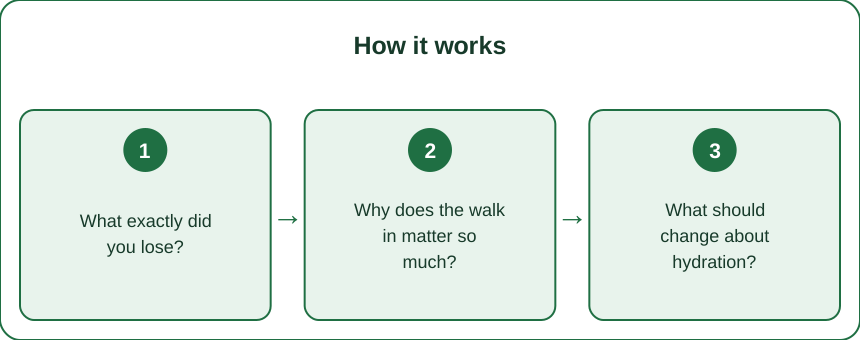
What exactly did you lose?
Plasma volume expansion is the first and largest adaptation, and the first to go. Heat-acclimatised people carry more blood plasma, which supports both cooling and cardiac output. It builds within days to weeks of heat exposure and decays on a similar timescale.
Your sweat onset threshold shifts back. Acclimatised bodies start sweating sooner and at a lower core temperature. Deacclimatised, you heat up further before cooling starts, which is why the first ten minutes feel disproportionately hard.
Sweat becomes saltier again. Acclimatisation makes sweat more dilute, conserving sodium. Losing it means more electrolyte loss for the same sweat volume.
Heart rate at a given effort rises. This is the most measurable change and the one people notice as classes feeling cardiovascularly harder rather than muscularly harder.
Most of it decays within one to three weeks of reduced heat exposure, which lines up almost exactly with the first cool fortnight of autumn.
And it rebuilds quickly - most of the adaptation returns within one to two weeks of regular exposure, which is the actual good news here.
Why does the walk in matter so much?
Arriving cold means starting from a bigger gap. Your skin is cool, your peripheral blood vessels are constricted, and the transition to a 35C room is more abrupt than it was in August when you arrived already warm.
Vasoconstriction from cold exposure takes time to reverse, so early in class your cooling system is still partly shut down while the heat load has already started.
You have probably sweated less all day, which means you have had less cue to drink and are more likely to arrive mildly dehydrated without noticing.
Arrive ten minutes early and sit in the room. This is the single most effective fix, and it costs nothing but scheduling.
Warm hands and feet before class if you commuted in the cold. Cold extremities take a surprisingly long time to come back and they affect how the whole class feels.
And do not layer up during class to feel warmer. The problem is not warmth, it is the abruptness of the transition, and extra layers reduce evaporative cooling exactly when you need it.
What should change about hydration?
Start earlier in the day, not in the studio. In autumn thirst cues are weaker because you are sweating less in daily life, so drinking is now a scheduled activity rather than a responsive one.
Add electrolytes back for the transition weeks. With deacclimatised, saltier sweat, plain water in high volume is less effective and, at extremes, counterproductive.
Aim for pale yellow, not clear. Clear urine before a hot class often means you have diluted sodium rather than hydrated well.
Drink small amounts during class rather than large ones. Large volumes mid-class sit uncomfortably in flexion-heavy pilates work and do not absorb faster.
Weigh yourself before and after class once, out of curiosity. A loss over about two percent of body weight tells you your intake needs adjusting, and most people are surprised.
And rehydrate over the following four hours, not in ten minutes. Post-class fluid replacement works better spread out and paired with food containing sodium.
What Nobody Tells You About Deacclimatisation
It happens over holidays too, not just seasons. Two weeks off in a cool climate produces the same effect, which is why the first class back after a break is disproportionately hard and people wrongly read it as lost fitness.
Studios often run hotter in autumn without changing the thermostat. The room heats faster and holds heat better when the building envelope is cool, and humidity control behaves differently - so a nominal 35C class can feel different from the same setting in July.
Humidity is the variable that actually determines difficulty. At high humidity sweat does not evaporate, so cooling fails even at a lower temperature. If a class feels unusually brutal, humidity is a more likely explanation than temperature.
The dizziness usually comes when you stand up, not during the work. That is postural blood pressure plus heat, and it is worth sitting up slowly and deliberately for the first few classes back.
Caffeine before a hot class is a mixed bag. It is not the dehydrator it was once claimed to be, but it does raise heart rate in a setting where heart rate is already the limiting factor.
And two classes a week maintains most of the adaptation. Once a week is where people report the winter never getting easier, because they deacclimatise between sessions all season.
How should the first two weeks be structured?
Go more often, not less. Three sessions in the first ten days rebuilds most of the adaptation. Backing off because it feels hard extends the difficult phase indefinitely.
Take an easier version of the class. Fewer reps, more rest at the back of the mat, and a lower position on anything with options. Attendance is the stimulus, not intensity.
Position yourself near the door or a vent for the first few classes if you tend to overheat.
Skip the hottest class on the timetable during the transition. The heated-but-not-extreme option is a better rebuilding stimulus than a class you cannot complete.
Expect it to take one to two weeks, and tell yourself that in advance so a hard class does not read as a decline.
And leave the room if you feel unwell. Nausea, headache, goosebumps in a hot room, confusion, or stopping sweating are reasons to get out immediately and cool down. This is general information, not medical advice, and heat illness warrants medical attention rather than persistence.
FAQ: Hot Pilates in Autumn, Answered
How long does it take to lose heat acclimatisation?
Meaningful decay within one to three weeks of reduced heat exposure, with plasma volume changes going first.
How long to get it back?
Most of it within one to two weeks of regular exposure - typically three to five sessions.
Should I go less often if classes feel too hard?
No, that is what prolongs it. Go as often, work less hard within the class.
Why do I feel dizzy standing up but fine on the mat?
Combined postural blood pressure drop and heat-driven vasodilation. Stand up slowly, and sit back down at the first sign of it.
Do I need electrolytes or is water enough?
During the transition weeks, when sweat is saltier, electrolytes are genuinely useful. Once re-acclimatised, most people are fine with water plus normal meals.
This is general information, not medical advice. Persistent dizziness, nausea, or headaches after class warrant a conversation with a doctor.
TL;DR:
- Summer gave you partial heat acclimatisation from daily life, and it decays within one to three weeks once the weather cools.
- Higher plasma volume, earlier sweat onset, and more dilute sweat are the specific things you lost - all rebuild in one to two weeks.
- Arrive ten minutes early and sit in the heated room; the cold walk in is why the first ten minutes are the worst part.
- Add electrolytes during the transition weeks, drink earlier in the day, and aim for pale yellow rather than clear.
- Go more often, not less, and take an easier version of the class - attendance is the stimulus.
Leave the room for nausea, headache, goosebumps in a hot room, or if you stop sweating. That is heat illness, not a tough class.
See It in Motion
Seen here: High Waist 8” Yoga Shorts — shop similar styles on bubblelime.com
Keep Reading
This article is for general informational and styling purposes only. Fit, sizing, and product availability may vary.