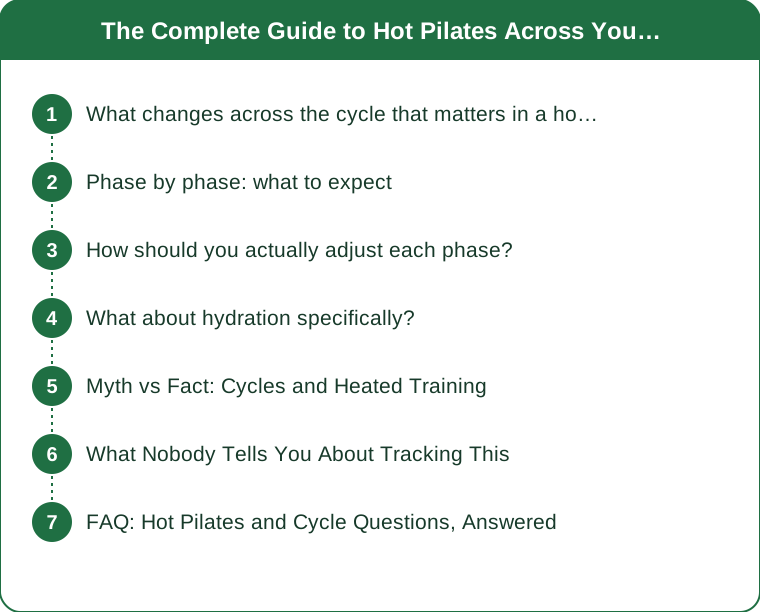
The Complete Guide to Hot Pilates Across Your Menstrual Cycle
Quick Answer: Hot pilates feels hardest in the luteal phase — the roughly two weeks before your period — because progesterone raises core body temperature by around 0.3 to 0.5 degrees Celsius, shifts the sweating threshold later, and increases perceived effort. The practical adjustments are extra hydration with electrolytes, a cooler spot in the room, and permission to reduce intensity rather than assuming you have lost fitness. Nothing about this requires skipping class, but ignoring it makes for a miserable month.
Week one after your period: you glide through class.
Two weeks later, the same class at the same temperature has you sitting down at minute twenty.
Same studio, same instructor, same you. Here is what actually changed, phase by phase.
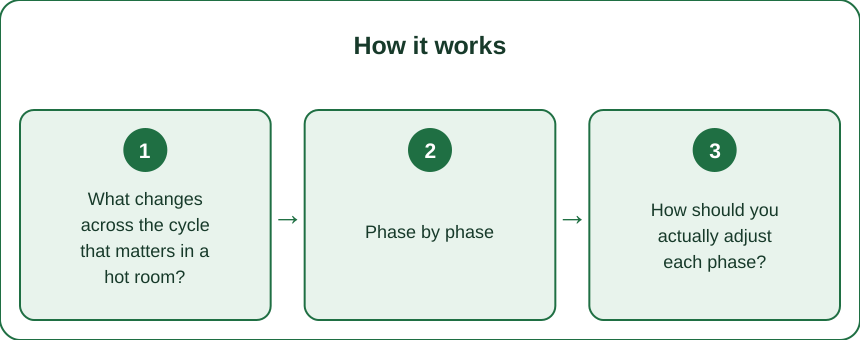
What changes across the cycle that matters in a hot room?
Four physiological shifts, and heat magnifies all of them.
Core body temperature rises after ovulation. Progesterone has a thermogenic effect that raises basal body temperature by roughly 0.3 to 0.5 degrees Celsius through the luteal phase. In an ordinary room this is barely noticeable. In a room heated to 35 degrees or more, starting half a degree higher means you reach an uncomfortable core temperature sooner, and there is less headroom before your body starts protesting.
Your sweating threshold shifts later. Research on thermoregulation across the cycle suggests the core temperature at which sweating and skin blood flow increase is elevated in the luteal phase. In practical terms, you get hotter before your cooling system fully engages — which is precisely the wrong adaptation for a heated class.
Fluid balance shifts. Both oestrogen and progesterone influence fluid regulation and sodium handling. Many women retain fluid premenstrually while simultaneously feeling less well hydrated, and the sensation of thirst does not always track actual need.
Perceived effort rises independently of measurable performance. This is one of the most consistent findings in this area — the same workload feels harder in certain phases even when objective output is similar. Combined with heat, which raises perceived effort on its own, the effects stack.
None of this means your fitness changed. Strength across the cycle is much more stable than subjective experience suggests, and individual variation is large. But the experience is real, and treating it as weakness rather than physiology is the mistake.
Phase by phase: what to expect
Menstrual phase (days 1 to 5, roughly)
Hormones are at their lowest, and core temperature drops back down. Many women report that once the first day or two passes, heat tolerance is actually good in this phase. The limiting factors are cramping, fatigue and low iron rather than temperature. Some find gentle movement genuinely relieves cramps; others need a lighter day or a rest day, and both are legitimate.
Follicular phase (roughly days 6 to 14)
Oestrogen rises, core temperature stays low, and this is where most women feel best in a hot room. Heat tolerance is at its highest, perceived effort at its lowest, and recovery tends to be quick. This is the phase to schedule harder classes, longer sessions, or anything you want to feel good at.
Ovulation (around day 14)
A brief window with a spike in oestrogen and rising temperature. Some women feel excellent here; others notice a sudden shift in heat tolerance from one class to the next. Worth noting in a log, because the transition can be abrupt.
Early luteal (roughly days 15 to 22)
Progesterone rises and core temperature climbs. The room starts feeling hotter than it did, sweating begins later relative to how hot you feel, and classes require more effort for the same output. This is where the confusion usually starts, because nothing external changed.
Late luteal (the final 5 to 7 days)
The hardest window for most people. Progesterone and oestrogen both drop sharply toward the end, sleep quality typically worsens, appetite and mood shift, and physical symptoms like bloating and breast tenderness arrive. Combined with elevated core temperature for most of the phase, this is where people conclude they have lost fitness. They have not — they are training in the least favourable physiological window in the hottest room they attend.
How should you actually adjust each phase?
Practically, and without turning your training into a spreadsheet.
Front-load intensity into the follicular phase where your schedule allows. If you attend four classes a week and one of them is the hardest format the studio offers, put it in week one or two after your period. This is the single most useful scheduling change and it costs nothing.
In the luteal phase, change position in the room. Most heated studios have meaningful temperature variation — back rows and spots near doors or vents are noticeably cooler. Moving there for two weeks a month is a small change with a real effect, and there is nothing to prove by staying in the hottest corner.
Increase fluid and electrolytes in the luteal phase specifically. Sodium losses in heated classes are substantial, and fluid regulation is already shifted. Drinking plain water in large volume without electrolytes can make you feel worse, not better. Start hydrating the day before rather than in the hour before class.
Give yourself explicit permission to take a break in class. Sitting out a block, dropping to a modification, or leaving early during the luteal week is not a failure of effort — it is a correct response to a genuinely different physiological state. The people who keep attending consistently are the ones who allow this.
Reduce expectations rather than attendance. Skipping the luteal weeks entirely means missing half your training every month. Attending at a reduced intensity keeps the habit intact and produces far better long-term results.
Watch iron if your periods are heavy. Heavy menstrual bleeding is a common cause of low iron in women, and low iron produces exactly the symptoms people blame on the heat: breathlessness, fatigue, poor heat tolerance and elevated heart rate. If the whole month feels hard rather than just one phase, this is worth a blood test rather than a training adjustment.

What about hydration specifically?
It is the highest-leverage variable in a heated class, and cycle phase changes what you need.
Sweat losses in a heated class are substantial, and they contain sodium as well as water. Replacing only the water dilutes what remains, which is why some people feel light-headed after drinking a litre of plain water post-class.
Start the day before, not the hour before. Fluid taken in the last thirty minutes largely ends up in your bladder during class. Consistent intake across the preceding 24 hours is what actually shows up as usable fluid.
Add electrolytes in the luteal phase and in hot weather. Sodium is the one that matters most; potassium and magnesium are secondary. A commercial electrolyte drink or simply a pinch of salt with your water and a properly salted meal beforehand both work.
Do not use urine colour alone as your guide. It is a rough indicator that is affected by supplements, medication and how recently you drank. Combining it with body weight before and after class gives a far more useful picture.
Weigh yourself before and after a class once, out of curiosity. The difference is almost entirely fluid, and it tells you how much you actually lose in your studio, in your usual class. Most people are surprised, and it makes the replacement target concrete rather than theoretical.
Caffeine before a hot class is worth reconsidering in the luteal phase. It raises heart rate and core temperature modestly, both of which are already elevated. If you rely on it, take it earlier rather than immediately before.
Late summer compounds everything. Arriving at a heated class already dehydrated from a hot day is a completely different starting point from arriving in November. During the luteal week in warm weather, the two effects stack, and this specific combination is where most people have their worst class of the month.
Myth vs Fact: Cycles and Heated Training
Myth: You should not exercise on your period. Fact: There is no physiological reason to avoid it, and many women find gentle movement relieves cramping. Adjust intensity to how you feel rather than following a rule.
Myth: You lose fitness in the luteal phase. Fact: Objective performance is far more stable than subjective experience. Perceived effort rises considerably more than actual capacity falls.
Myth: Cycle-syncing programmes are well established. Fact: The broad physiology is well described, but detailed prescriptive protocols are built on limited research, and individual variation is large. Track your own pattern rather than adopting someone else’s chart.
Myth: If you take hormonal contraception, none of this applies. Fact: It changes the pattern rather than removing it. Combined contraception alters the temperature profile, and many users report a more consistent experience across the month — but not universally.
Myth: Feeling terrible in a hot class means you are not fit enough. Fact: In a heated room, heat tolerance is often the limiting factor rather than fitness, and heat tolerance genuinely varies with cycle phase, sleep, hydration and the weather outside.
Myth: Sweating more means it is working better. Fact: Sweat rate reflects heat load, hydration, acclimatisation and cycle phase far more than it reflects effort or results.
What Nobody Tells You About Tracking This
Two months of data settles arguments that speculation never will. Record cycle day, class type, how hard it felt out of ten, and how you slept. Four numbers, thirty seconds after class. Almost nobody does this, and the people who do stop being confused by their own month.
Your pattern may not match the textbook. A meaningful minority of women report their hardest classes in the follicular phase or around ovulation rather than late luteal. If your data disagrees with the general description, trust your data.
Sleep explains more variance than cycle phase for many people. When you track both, it often turns out that the terrible classes cluster around bad nights, which themselves cluster in the late luteal phase. The cycle is the upstream cause but sleep is the mechanism, and sleep is more actionable.
Studio temperature is not constant either. Rooms vary by class time, instructor preference, how full the class is and the weather outside. A packed evening class in August is a genuinely different environment from a half-empty morning class in November, and attributing that difference to your cycle will confuse your data.
Heat acclimatisation partly offsets cycle effects. Consistent attendance produces genuine heat adaptation within one to two weeks — earlier sweating, more dilute sweat, expanded plasma volume. Regular attenders experience smaller cycle-related swings than sporadic ones, which is a good argument for consistency over intensity.
Perimenopause changes the whole picture. As cycles become irregular, the predictable phase pattern breaks down and heat tolerance can shift for entirely different reasons. If your long-standing pattern stops making sense and your cycles have changed, that is worth discussing with a doctor rather than troubleshooting as a training problem.
If you experience dizziness, nausea, headache or confusion in a heated class, leave the room and cool down. Severe heat symptoms are a medical matter, and anyone who is pregnant or has a cardiovascular condition should talk to a doctor before attending heated classes. This is general information, not medical advice.
FAQ: Hot Pilates and Cycle Questions, Answered
Which week will feel best?
For most women, the first two weeks after their period — low core temperature, rising oestrogen, better sleep. Schedule your hardest classes there if you can.
Should I skip class in the week before my period?
Usually no. Reduce intensity, move to a cooler spot, hydrate more, and allow yourself to modify. Skipping half the month costs far more than attending at 80 percent.
Why do I sweat less in some classes despite feeling hotter?
The sweating threshold shifts later in the luteal phase, so you feel hot before your cooling response fully engages. It is one of the more uncomfortable parts of that phase.
Does hormonal contraception help?
It alters the hormone pattern, and many users report a more even experience across the month. Responses vary considerably, so track your own.
How much should I be drinking?
Enough that your weight is close to unchanged before and after class. Weigh yourself once to find your own number rather than following a generic figure, and include sodium.
Is it normal to feel wiped out for hours after a hot class?
Some fatigue is normal, particularly early on. Persistent exhaustion after every class suggests under-hydration, under-fuelling, or possibly low iron — worth investigating rather than pushing through.
Can I train hard on day one of my period?
If you feel up to it, yes. Many women find their heat tolerance recovers quickly once bleeding starts, because core temperature has already dropped.
TL;DR:
- Progesterone raises core temperature about 0.3 to 0.5 degrees and delays the sweating threshold — heated rooms amplify both.
- The follicular phase (first two weeks after your period) is when heat tolerance is best. Schedule hard classes there.
- The late luteal week is hardest, and that is physiology, not lost fitness.
- Adjust with electrolytes, a cooler spot in the room, and permission to modify — not by skipping half the month.
- Track cycle day, perceived effort and sleep for two months. Your pattern may not match the textbook, and yours is the one that counts.
- Heavy periods plus persistent breathlessness and fatigue is an iron question, not a training question.
Consistent attendance builds heat adaptation, which shrinks the swings. The people who ride out the hard weeks at reduced intensity end up with the smoothest months.
See It in Motion
Seen here: Racerback Tank Top - White — shop similar styles on bubblelime.com
Keep Reading
This article is for general informational and styling purposes only. Fit, sizing, and product availability may vary.