The Complete Guide to Hot Pilates During a Late Summer Heat Wave
Quick Answer: In a heat wave, studios often start well above their baseline temperature, humidity from outside air and from a full class runs higher, and you arrive already partly dehydrated from the rest of your day. The result is that a class you have taken fifty times becomes measurably harder. Adjust by hydrating with electrolytes from the previous evening, arriving early to acclimatise, positioning away from heat sources, and accepting a reduced intensity as a correct decision rather than a failure.
It is 33C outside. The studio is already 35C when you walk in, before anyone has turned anything on. This class is not going to be the class you took in April.
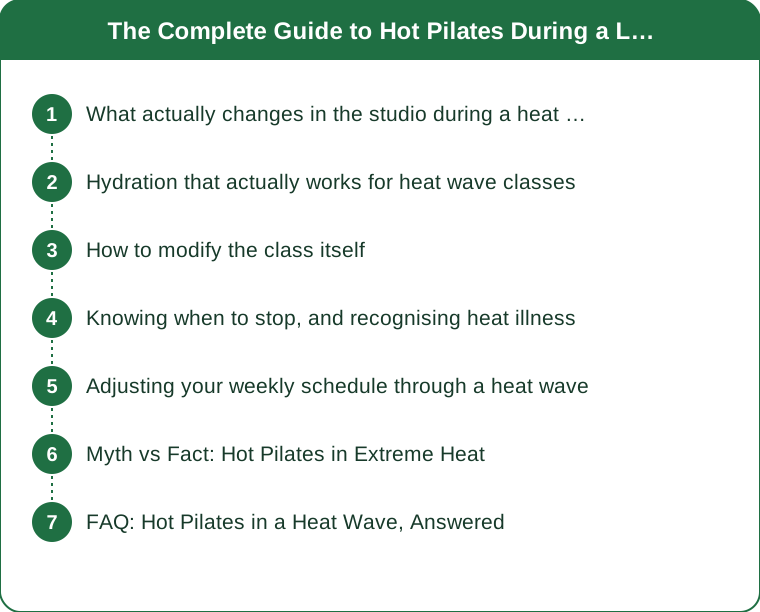
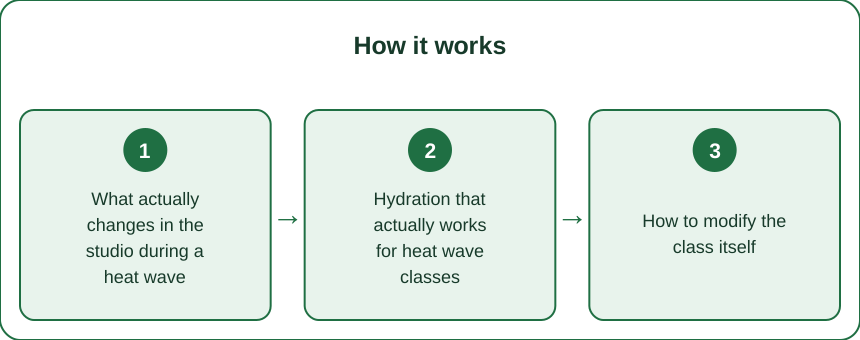
What actually changes in the studio during a heat wave
More than the number on the thermostat, and understanding it explains why the class feels so different.
The starting temperature is higher
Studios are heated to a target, but that target assumes a normal starting point. During a heat wave, the room may already exceed the target before heating begins, and many systems have no mechanism to cool. The result is a room running above its intended temperature for the whole class.
Building thermal mass matters here. A studio in a building that has been absorbing heat for a week of high temperatures radiates that heat back regardless of what the system does. This is why the fourth day of a heat wave is harder than the first.
Humidity is the bigger problem
Hot pilates studios are usually designed for dry heat, in the range of 35-38C at relatively low humidity. During a humid heat wave, incoming air carries far more moisture, and a full class of people sweating adds substantially more.
High humidity blocks evaporative cooling. Sweat runs off rather than evaporating, so you lose fluid without the cooling benefit. This is the single largest reason a familiar class feels unmanageable, and it is invisible on a thermometer.
Studio ventilation varies enormously. Some studios manage humidity actively; many do not. A studio that feels heavy and close rather than hot and dry is one where humidity is the limiting factor.
You arrive in a different state
Baseline hydration is lower during a heat wave. You have been sweating all day, in transit, at work, walking to the studio. The class does not start from neutral.
Sleep is often worse in hot weather, and poor sleep raises perceived exertion and reduces heat tolerance.
Cumulative heat exposure matters. Several consecutive hot days produce genuine fatigue independent of any single session, which is why heat waves feel progressively harder rather than becoming easier.
Hydration that actually works for heat wave classes
The most common mistake is treating hydration as something that happens in the studio.
Start the evening before
Fluid balance is restored over hours, not minutes. Drinking a large volume 20 minutes before class produces a full stomach and a bathroom trip, not hydrated tissue. Consistent intake through the previous day and evening is what determines your starting state.
A practical target: drink to the point where urine is pale straw coloured through the afternoon before an evening class. It is imprecise but it is far better than guessing, with the caveat that supplements and some foods change urine colour independently.
Sodium is not optional in heat
Heavy sweating loses meaningful sodium as well as water. Replacing fluid alone dilutes what remains, which is why people who drink a great deal of plain water during hot classes sometimes feel worse rather than better - headachy, weak, and still thirsty.
Options that work: an electrolyte tablet or powder in your water, a pinch of salt in a drink beforehand, or salty food with the meal before class. The exact vehicle matters far less than including sodium at all.
A caution worth stating: drinking very large volumes of plain water quickly during prolonged heavy sweating carries a small but real risk of hyponatraemia, which is dangerous. Include sodium and drink to thirst rather than to a target volume.
During and after class
Small, frequent sips beat large volumes. A large volume of cold water during intense abdominal work is uncomfortable and does not absorb faster.
Rehydration continues for hours afterwards. Weighing yourself before and after class, if you are inclined, gives a rough sense of fluid lost - roughly a litre and a half of fluid for every kilogram lost is a common guideline, taken in over several hours rather than immediately.
Alcohol after a hot class in a heat wave is a poor idea, since it acts as a diuretic at exactly the point where you are trying to restore fluid balance.
How to modify the class itself
Adjusting is a skill, and doing it deliberately is very different from struggling through.
Position matters more than usual
Heat sources are not evenly distributed. Panels, vents, and radiant heaters create hot zones, and the back and edges of a room are frequently several degrees cooler than the centre or the area beneath a heater.
Near a door or a fan is the coolest spot in most studios. In a heat wave, arriving early to claim it is a reasonable strategy rather than an admission of weakness.
Avoid the mirror wall if the studio has one, since it often sits opposite the heat source and reflects rather than absorbs.
Reduce intensity deliberately, not accidentally
Take the option to slow the tempo rather than reduce range. Slower, controlled movement generates less metabolic heat while preserving the quality of the work.
Drop the pulse count and keep the position. Isometric holds produce less heat than repeated dynamic work at the same difficulty.
Take child’s pose or a seated rest without waiting to feel unwell. Resting before you need to is the entire skill. In heat, waiting until you feel bad means waiting until you are already in trouble.
Skip the final round. In a heat wave, the last block of a class is where most incidents happen, because heat has accumulated for 45 minutes and everyone is pushing to finish.
Practical class-day adjustments
Arrive 10-15 minutes early and sit in the room. Acclimatising gradually is far more comfortable than walking in and starting immediately.
Bring two towels. One for the mat, one for you. A slippery mat in humid conditions is both a frustration and a genuine injury risk.
Wear less. Minimal, non-absorbent, quick-drying fabric. Cotton holds sweat against skin and gets heavy, which makes everything harder.
Consider a cooler class time. Early morning classes during a heat wave are meaningfully more manageable than evening ones, since the building has cooled overnight.

Knowing when to stop, and recognising heat illness
This section matters more than any performance advice in the guide.
The symptoms that mean stop immediately
Dizziness or light-headedness that does not resolve with a brief rest. Sit down, get to a cooler area, and drink something with electrolytes.
Nausea. A common early sign of heat exhaustion and a clear signal to leave the room.
Headache during class. Often a dehydration signal and not something to push through.
Chills or goosebumps in a hot room. A serious sign that thermoregulation is failing. Leave the room immediately.
Stopping sweating while still hot. Among the most concerning signs, potentially indicating heat stroke, which is a medical emergency.
Confusion, disorientation, or difficulty following instructions. Emergency. Seek medical help.
Who should be more cautious
People new to hot classes have not developed heat adaptation and should not begin during a heat wave. Start when conditions are normal.
During pregnancy, raised core temperature carries specific concerns and hot classes are generally advised against - discuss it with a midwife or doctor rather than deciding alone.
Cardiovascular conditions, low or unstable blood pressure, and diabetes all interact with heat stress. Medical advice before hot classes is genuinely warranted rather than a formality.
Certain medications affect thermoregulation and fluid balance, including some diuretics, antihistamines, and psychiatric medications. Ask a pharmacist if you are unsure whether yours is on that list.
If you are unwell, recovering from illness, or have had a fever recently, skip hot classes entirely until you are fully recovered.
After class in a heat wave
Cool down gradually rather than stepping into air conditioning immediately, which is uncomfortable and can cause dizziness.
Cool the neck, wrists, and face with cool water. These areas have surface blood flow and reduce perceived heat quickly.
Continue drinking with electrolytes for the next few hours, not just immediately after.
Watch for delayed symptoms. Heat exhaustion can develop after leaving the studio, particularly if you head straight into a hot commute.
This is general information, not medical advice. Suspected heat exhaustion or heat stroke requires immediate cooling and medical attention.
Adjusting your weekly schedule through a heat wave
The strategic view, which most people skip entirely.
Reduce frequency, not just intensity
Heat exposure is cumulative. Three hot classes in a week during a heat wave, on top of daily heat exposure, is a substantially larger physiological load than the same three classes in April. Reducing to two, or replacing one with a non-heated session, is a sensible adjustment rather than a step backwards.
Watch morning resting heart rate. An elevation of several beats sustained across days suggests accumulated strain and is a useful, objective signal to reduce load.
Sequence sessions sensibly
Avoid stacking a hot class immediately after outdoor training in the heat. Two heat exposures in one day compound, and this is a common route to feeling genuinely unwell.
Put hot classes on days with lighter overall load and keep hard strength or conditioning work for cooler parts of the day.
Use the heat wave productively
Heat adaptation is real and builds in ten to fourteen days of consistent exposure - expanded plasma volume, earlier onset of sweating, lower core temperature at a given workload. If you train through a heat wave sensibly, you emerge genuinely better adapted.
But adaptation requires recovery to occur. Training hard in heat every day without recovery produces fatigue, not adaptation. The distinction is entirely in how much you back off.
Expectations for performance
Expect to be worse in class, and treat that as information rather than failure. Reduced range, fewer reps, and more rests during a heat wave reflect the environment accurately.
The rebound afterwards is usually noticeable. The first class after a heat wave breaks often feels dramatically easier, which is partly the environment and partly genuine adaptation you built while feeling terrible.
And the most useful mindset: during a heat wave, the goal of a hot class is to complete it safely and maintain the habit, not to progress. Progress resumes when the weather does.
Myth vs Fact: Hot Pilates in Extreme Heat
Myth: If the studio is hotter, you get a better workout. Fact: Higher temperature increases heart rate and perceived effort without increasing the training stimulus to muscle. Beyond the intended range, extra heat adds risk rather than benefit, and it usually reduces the quality of the movement you are able to produce.
Myth: Sweating more means you are burning more calories. Fact: Sweat volume reflects thermoregulation, not energy expenditure. Weight lost during a hot class is fluid and returns as soon as you rehydrate. The extra cardiovascular work of cooling has a modest energy cost, but it is far smaller than the sweat suggests.
Myth: You should push through because the heat is the point. Fact: The heat is a feature of the format, not the goal of the session. Pushing through dizziness, nausea, or chills in a hot room is how heat exhaustion happens, and none of those symptoms are things experienced practitioners work through.
Myth: Drinking lots of water is enough. Fact: Heavy sweating loses sodium as well as fluid, and replacing water alone can leave you feeling worse. Very large volumes of plain water during prolonged sweating carry a small risk of hyponatraemia. Include electrolytes.
Myth: If you can tolerate the heat, you are adapted. Fact: Perceived tolerance improves faster than physiological adaptation, which is a genuine hazard - it means people push harder before their body can actually handle it. Adaptation takes ten to fourteen days of consistent exposure with recovery in between.
Myth: A hot class is a good way to acclimatise for a hot holiday. Fact: It does produce some heat adaptation, which is a legitimate use. But adapting in a dry heated studio transfers imperfectly to a humid climate, where evaporative cooling is the limiting factor.
FAQ: Hot Pilates in a Heat Wave, Answered
Should I skip hot pilates during a heat wave?
Not necessarily, but reduce frequency and expect lower intensity. If you are new to hot classes, are unwell, are pregnant, or have a cardiovascular condition, waiting for normal conditions is the better decision.
Why is class so much harder when it is hot outside?
The studio often starts above its target temperature, humidity is higher from both outside air and the class itself, and you arrive already partly dehydrated. Humidity is usually the biggest factor because it prevents sweat from evaporating and cooling you.
How much water should I drink before a hot class?
Focus on the previous day and evening rather than the hour before. Aim for pale straw coloured urine through the afternoon, include sodium, and take small sips during class rather than large volumes.
What are the warning signs I should leave the room?
Dizziness that does not resolve with rest, nausea, headache, chills or goosebumps in a hot room, or stopping sweating. Confusion or disorientation is a medical emergency. None of these are things to push through.
Will I lose progress if I take a week off during a heat wave?
No. A week of reduced training produces minimal loss of strength or capacity, and it prevents the accumulated fatigue that causes longer interruptions. Maintaining a lighter version of the habit is more valuable than forcing full sessions.
Does hot pilates help me handle summer heat better?
To an extent. Consistent exposure over ten to fourteen days produces genuine heat adaptation, including expanded plasma volume and earlier sweating. That adaptation transfers best to dry heat and less well to humid conditions.
TL;DR:
- In a heat wave the studio often starts above target, and humidity - not temperature - is usually what breaks the class.
- Hydrate from the previous evening with sodium included; drinking a litre 20 minutes before does almost nothing.
- Arrive early to acclimatise, position near a door or fan, and slow the tempo rather than reducing range.
- Rest before you feel bad, not after - in heat, waiting for symptoms means waiting too long.
- Cut frequency, not just intensity; heat exposure accumulates across a week and so does the fatigue.
The class did not get harder. The room started 4C hotter, the air will not take your sweat, and you walked in already down a litre.
See It in Motion
Seen here: High Waist Bootcut Yoga Pants with Hidden Pocket — shop it on bubblelime.com
Keep Reading
This article is for general informational and styling purposes only. Fit, sizing, and product availability may vary.