The Complete Guide to Hot Pilates Through the Cold Months
Quick Answer: The same 95°F studio feels substantially hotter in winter because you arrive with a lower core temperature and less heat acclimation than you had in summer — heat tolerance fades within one to two weeks of cool weather. Expect a genuine adjustment period in the first cold weeks, hydrate more deliberately (winter thirst signals are weaker), allow 15 to 20 minutes of cool-down before going outside, and layer for the exit rather than the entrance. The post-class temperature transition is the part that causes most winter problems, not the class itself.
You did hot pilates three times a week all summer and the heat stopped registering. First genuinely cold week, same studio, same instructor, and you’re sitting down at minute twenty wondering what happened.
Nothing about your fitness changed. Your heat acclimation did, and so did four other things nobody warns you about.
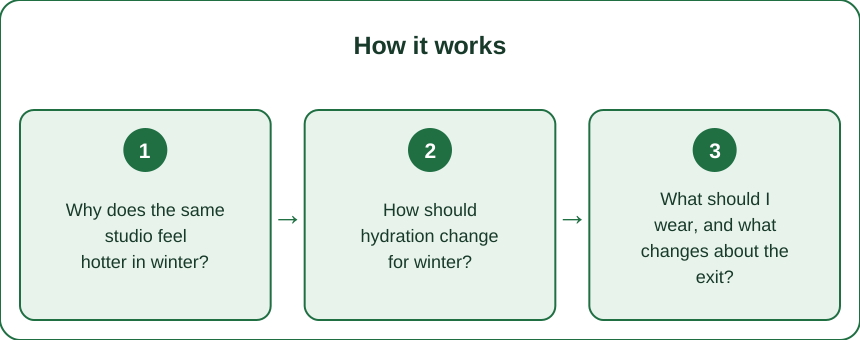
Why does the same studio feel hotter in winter?
Because heat acclimation is fast to build and fast to lose, and a cool October week takes most of it.
Heat acclimation — the set of adaptations that make hot environments tolerable — develops in 10 to 14 days of regular exposure and fades within one to two weeks without it. Through summer, you were acclimated by daily life: commuting, being outdoors, warm homes. In winter, the only heat exposure you get is the class itself.
Three classes a week is not enough to maintain full acclimation. It’s enough to maintain a partial version, which is why regulars find winter classes harder but not impossible. Someone attending five times a week will notice far less difference than someone attending twice.
You arrive with a lower core temperature. In summer you walk in already warm; the studio meets you halfway. In winter you arrive cool, and your body has to bridge a much larger gap — which it does by pushing heart rate higher earlier in the class.
Your baseline hydration is lower and you don’t notice. Thirst sensation is genuinely blunted in cold weather, and most people drink meaningfully less water in winter than summer. Walking into a heated class already down half a liter changes the experience substantially.
Studios sometimes run warmer in winter, not cooler. Some raise temperature or humidity because students arrive cold and complain about the first ten minutes. If the class feels hotter, it may actually be hotter — worth asking rather than assuming it’s you.
Skin behaves differently too. Cold, dry winter air compromises the skin barrier, and going from that state into a hot humid room produces more flushing and more irritation than the same transition in summer.
How should hydration change for winter?
Deliberately, on a schedule, because thirst won’t prompt you the way it did in July.
Thirst is a lagging indicator in any season and a worse one in cold weather. Cold exposure blunts thirst perception through a real physiological mechanism — peripheral vasoconstriction affects blood volume signaling. You can be meaningfully dehydrated in winter and not feel thirsty at all.
Front-load the day, not the hour. 500ml over the two to three hours before class is far more effective than 500ml in the fifteen minutes before, which mostly ends up needing a bathroom trip.
Sodium matters more than people think, even in winter. A hot pilates class produces the same sweat loss regardless of the season outside, and a typical class costs 500ml to a liter of fluid with meaningful sodium. Replacing water without sodium leaves you hydrated on paper and still flat.
300 to 500mg of sodium in a post-class drink covers most people. An electrolyte tablet, a pinch of salt in water, or simply a salty snack afterward all work.
Watch the coffee and alcohol shift. Winter typically brings more of both, and both affect fluid status. This isn’t a reason to stop either — it’s a reason to add water alongside them rather than assuming they count.
The practical check remains urine color, with the caveat that it’s imperfect. Pale yellow through the day, and if it’s consistently dark, the deficit is bigger than you think.
Winter-specific addition: warm fluids count. Herbal tea, broth, and warm water all hydrate identically to cold water, and people drink considerably more of them in cold weather. This is the easiest single fix for winter under-hydration.
What should I wear, and what changes about the exit?
Dress for the class as usual — and plan the twenty minutes after it far more carefully than you did in summer.
In-class clothing barely changes. Minimal, moisture-wicking, and fitted. Cotton is worse in winter than summer because it stays damp longer in cold air afterward, which is the specific mechanism behind post-class chills.
The exit is where the real planning happens. You leave the studio with elevated core temperature, dilated peripheral blood vessels, and damp skin — the exact combination that loses heat fastest. Stepping into 35°F air in that state is a genuine shock.
Change out of damp clothing before leaving. This is the single highest-value winter habit and the one most often skipped because it’s inconvenient. Damp fabric against skin in cold air is how a pleasant class becomes an unpleasant hour.
Bring a dry base layer, dry socks, and a hat. Heat loss from the head is meaningful when you’re flushed and damp, and hair wet with sweat in cold air is uncomfortable for the entire journey home.
Cool down for 15 to 20 minutes before going outside. Sit in the lobby, drink something, let heart rate and core temperature settle. Walking straight from a 95°F room into freezing air is where dizziness and lightheadedness actually happen — more often than during the class itself.
Warm up the car before you get in it, if that’s an option. A cold car seat after hot pilates is memorably unpleasant, and the shivering that follows undoes the relaxed state the class produced.
Skin care changes too. Hot humid class, then cold dry air, then indoor heating is three barrier insults in ninety minutes. Rinse and moisturize within thirty minutes of class rather than waiting until you get home.
What Nobody Tells You About the Winter Hot Pilates Season
The winter students are a different group, and the class dynamic changes with them.
Studios get busier in January and quieter in November. If you want space and instructor attention, November and early December are the best weeks of the year to attend — and January is when your usual spot disappears.
Your progress will feel like it stalled and probably hasn’t. The added difficulty from lost heat acclimation masks fitness gains. Two to three weeks into the cold season, when partial acclimation rebuilds, people typically find they’re further ahead than they thought.
Illness changes the calculation. Hot pilates while fighting something is worse than skipping — elevated core temperature plus dehydration plus an immune system already working is a genuinely bad combination. The old rule of thumb about symptoms above the neck being fine is more forgiving than a hot room warrants. When in doubt, skip it.
The studio air gets drier as heating runs. Many studios humidify, and many don’t do it well in winter. A dry hot room feels easier and dehydrates you faster, which is a genuinely dangerous combination because the discomfort signal is muted.
Winter is when people build the strongest attendance habits. There’s less competing for evenings, and the contrast between cold outside and warm studio becomes a genuine draw rather than an obstacle. Many regulars report winter as their most consistent season, once they get through the first three weeks.
And the thing that surprises people most: if you keep attending through the cold months, the first hot week of spring is remarkable. You’ll be more heat-acclimated than almost everyone around you, and outdoor summer training will feel dramatically easier than it did the previous year.
This is general information, not medical advice. Anyone with cardiovascular conditions, who is pregnant, or on medications affecting thermoregulation should talk to a clinician about hot exercise environments.
How should I adjust the actual practice?
Lower expectations for three weeks, then rebuild — and change where you stand.
Take the back or the edge for the first few classes back into the cold season. Studios have real temperature gradients, and the back and edges run several degrees cooler than the center. There’s no status attached to where you stand, and the first weeks are exactly when the cooler spot is useful.
Plan to take breaks and treat them as part of the class, not a failure. Sitting out 30 seconds and returning is a better session than pushing through and leaving at minute thirty.
Reduce frequency for two weeks if needed. Three classes a week where you complete all three beats four where two go badly. Then rebuild frequency, which also rebuilds acclimation.
Arrive earlier than usual and let the room acclimate you. Ten minutes lying in the room before class starts is genuine acclimation time, and it substantially reduces the shock of the first ten minutes.
Eat differently. Winter appetite runs higher and the class is unchanged. A light meal 90 minutes to two hours before class, avoiding anything heavy — the same rule as summer, but people forget it when meals get larger seasonally.
Track something objective. How many breaks you take, or whether you complete the full class. Perceived difficulty is a bad metric in a season where difficulty is externally inflated — a count of completed classes tells you far more.
Reassess at three weeks. If it’s still disproportionately hard, look at hydration, sleep, and illness before concluding it’s fitness. Those three explain nearly every case.
FAQ: Winter Hot Pilates Questions, Answered
Is it bad to go from a hot studio into freezing air?
For most healthy people it’s uncomfortable rather than dangerous, but it’s worth managing. Cool down 15 to 20 minutes, change out of damp clothes, cover your head, and don’t linger outside while still flushed. If you have a cardiovascular condition, discuss the transition with your doctor.
Why do I feel dizzy in winter classes when I never did in summer?
Usually lower baseline hydration plus reduced heat acclimation plus arriving with a lower core temperature. Front-load fluids across the day, add sodium, arrive early to acclimate, and take the back of the room for a few weeks.
Should I still go if I have a mild cold?
Generally not. Hot environments plus dehydration plus an immune response is a combination worth avoiding, and it’s also considerate to the room. A short walk or gentle mat work at home is the better call.
Does hot pilates help with seasonal mood?
Many people find it does — regular exercise, warmth, and routine all contribute, and the social element of a studio matters in a season when people get isolated. It’s not a substitute for treatment if seasonal mood changes are significant.
My skin got much worse when winter started. Why?
The cycle of hot humid room, cold dry air, and indoor heating is hard on the skin barrier. Rinse and moisturize within thirty minutes of class, switch to a cream cleanser, and add a barrier-repair moisturizer. It usually resolves within two to three weeks of adjusted care.
How long until winter classes feel normal again?
Most regulars report two to three weeks of consistent attendance. Attending more frequently shortens it, since the acclimation is driven by exposure.
This is general information, not medical advice.
TL;DR: The class is the same. Your heat acclimation, your hydration, and the twenty minutes afterward are not.
- Heat acclimation fades in one to two weeks of cool weather, which is why the same studio feels hotter in November.
- Winter thirst signals are genuinely blunted. Front-load 500ml across two to three hours before class, on a schedule rather than by feel.
- Add 300 to 500mg sodium afterward. Sweat loss is unchanged by the season outside.
- Cool down 15 to 20 minutes before going outdoors, and change out of damp clothes first — this is where winter dizziness actually happens.
- Take the back or edge of the room for the first few weeks. Studios have real temperature gradients.
- Arrive ten minutes early and lie in the room. It’s genuine acclimation time and it fixes the first ten minutes.
- Track completed classes, not perceived difficulty. Difficulty is externally inflated this season.
Give it three weeks before drawing any conclusion about your fitness. And if you keep going through winter, the first warm week of spring will be the easiest training you’ve had all year.
See It in Motion
Keep Reading
This article is for general informational and styling purposes only. Fit, sizing, and product availability may vary.