The Complete Guide to Hot Pilates When the Weather Turns Cold
Quick Answer: The studio stays at the same temperature; you do not arrive at the same temperature. In cold weather you enter class colder and stiffer, dehydrate more without noticing, and leave into air 25 degrees colder than the room. The adjustments that matter are a longer warm-up, deliberate hydration despite reduced thirst, a proper cool-down before going outside, and a change of clothing you actually carry.
This is general information, not medical advice.

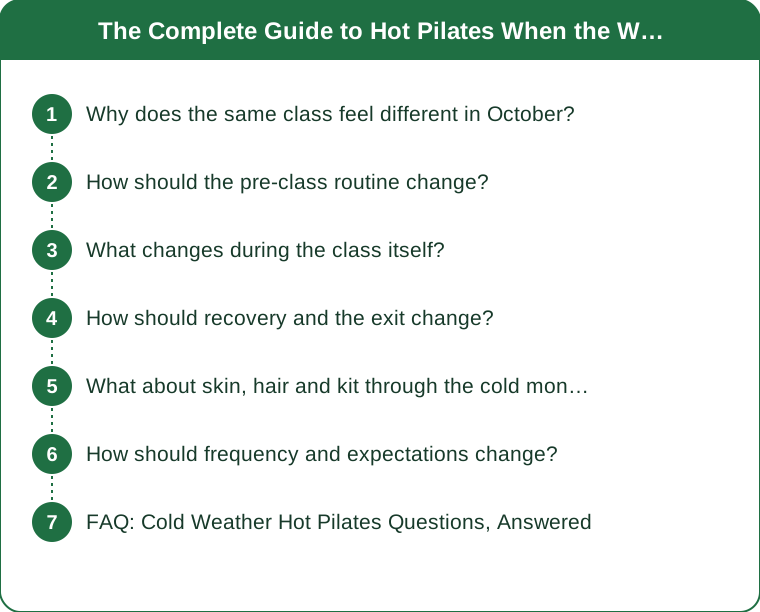
Why does the same class feel different in October?
You arrive colder and stiffer. Muscle and joint tissue is genuinely less compliant at lower temperatures, and the drop in ambient temperature between a July arrival and a November arrival is substantial. The room warms you, but it takes longer than most people allow.
The temperature differential is much larger. In August you might step from 26 degrees into a 38-degree studio — a 12-degree change. In January you might step from 2 degrees into the same room, a 36-degree change. Your cardiovascular system handles that shift, and it takes time.
Heart rate response is different. Coming in cold, heart rate tends to rise more sharply in the first ten minutes as peripheral circulation opens up. The class feels harder at the start and easier later, which is the opposite of the summer pattern.
Hydration is worse without feeling worse. Thirst is a less reliable signal in cold weather, and most people simply drink less through a winter day. You then sweat the same amount in class from a lower starting point.
Skin behaves differently. Cold, dry outdoor air plus indoor heating leaves the skin barrier more compromised, and a heated studio plus sweat plus friction on a mat is harder on it than the same class in summer.
And motivation genuinely changes. Leaving a warm house for a cold walk to a studio is a different decision from doing so in August, which is why attendance falls in autumn at almost every studio.
How should the pre-class routine change?
Arrive earlier than in summer. Ten to fifteen minutes in the room before class begins, rather than five. This is the single most useful change and it costs nothing.
Move before you arrive. Walking to the studio, or five minutes of gentle mobility at home, means you enter the room already warm rather than relying on the room to do all of it.
Do not stretch cold as a substitute. Static stretching a cold body before a heated class is neither necessary nor particularly safe. Movement is the warm-up; the heat and the class do the rest.
Hydrate through the day, not in the hour before. Steady intake across the day is absorbed properly; 750ml immediately before class produces discomfort and a bathroom trip rather than hydration.
Add electrolytes if you sweat heavily or attend frequently. Water alone across multiple weekly hot classes can leave sodium low, and the symptoms — headache, lightheadedness, sluggishness — are commonly mistaken for dehydration and treated with more water, which makes it worse.
Eat something small 60 to 90 minutes before. Appetite patterns shift in cold weather and arriving underfuelled is more common in autumn than in summer.
What changes during the class itself?
Expect the first ten minutes to feel harder. Coming in cold means a steeper rise in heart rate and a slower arrival at comfortable movement. This settles and it is not a sign of lost fitness.
Do not chase your summer range of motion in the first block. Tissue compliance builds over the class. The depth available at minute 40 is not available at minute five, and forcing it early is where the avoidable strains come from.
Position matters more when you arrive cold. Spots near a door or an outside wall are noticeably cooler, and in winter that difference is large enough to affect the first half of the class.
Watch the grip. Cold, dry hands and feet sweat later in the class than they do in summer, so the first section has less grip and the second has more. A towel over the mat manages both.
Expect your perceived effort to be higher for the same work. Coming in cold, dehydrated and short on daylight raises perceived exertion independently of anything happening in the class. A session that feels like a 7 in November may be the same work that felt like a 5 in July, and reading that as lost fitness is the most common autumn misinterpretation.
Take the breaks offered. The temptation in a cold season is to push through to stay warm; the heat stress is unchanged and the rules about stopping have not moved.
Stop and sit down for dizziness, nausea, headache, or a stop in sweating. Those are heat illness signs regardless of the season, and a cold day outside changes nothing about them.

How should recovery and the exit change?
Do not leave immediately. Stepping from 38 degrees into 2-degree air within a minute of finishing is unpleasant and unnecessary. Give it five to ten minutes.
Change out of wet kit before going outside, always. This is the single most important winter adjustment and the one most often skipped. Damp clothing in cold air makes you lose heat rapidly and is genuinely uncomfortable for the whole journey home.
Dry your hair or cover it. Leaving with wet hair in cold air is miserable and is a large part of why people stop attending evening classes in winter.
Rehydrate over the following two hours, not all at once. Include some sodium if the class was long or you sweat heavily.
Warm layers ready in the bag before class, not sourced afterwards. Decisions made while cold and tired default to speed.
Eat within an hour or so. Appetite is often suppressed immediately after a hot class and returns sharply later, which is how people end up eating badly at 10pm after an 8pm class.
What about skin, hair and kit through the cold months?
The skin barrier is under more strain than in summer. Cold outdoor air, indoor heating, a heated studio and sweat all compound. Reducing exfoliation frequency and adding a barrier-supporting moisturiser does more than any product change.
Shower promptly after class, and in warm rather than hot water. Hot water on skin that has just spent an hour sweating strips more than it cleans.
Body breakouts increase in autumn for many people, because damp kit stays damp longer in cold weather and the journey home is longer. Change immediately and wash kit after every session.
Kit dries much more slowly. A bag with damp clothes in a cold car overnight is a genuine hygiene problem. Unpack every time, without exception.
Hair takes longer to dry and breaks more easily when tied wet. Loosen it while damp rather than travelling home in a tight tie.
Mat towels become essential rather than optional as grip patterns change with drier hands. Wash them frequently; a heated studio is an excellent environment for anything living on a damp towel.
How should frequency and expectations change?
Two to four classes a week remains a reasonable range for most people, and it does not need to change with the season.
Expect a plateau in perceived progress over autumn. Less daylight, more disrupted sleep and higher life load all affect performance, and a flat few weeks in October is normal rather than diagnostic.
Combine sensibly with other winter training. If outdoor running or cycling has dropped off, hot pilates may now be a larger share of your total load than it was, and total load is what matters for recovery.
Attendance beats intensity through the cold months. The people who keep going through November are the ones who reduced the target rather than the frequency.
Book in advance. Autumn attendance falls, and a booked class is meaningfully more likely to be attended than an intended one.
Re-evaluate at the end of the season, not during it. Judging whether hot pilates is working for you in the middle of the darkest, busiest weeks of the year produces a distorted answer.
Change one variable if attendance drops, not several. The usual failure is deciding the class is not working, switching studio, switching time and switching format all in one week. Move the class time first — for most people who stop attending in autumn, the time of day is the actual problem and the class was fine.
Morning classes hold up better through winter than evening ones, for most people, because the decision is made before the day has had a chance to intervene. The cost is a colder, stiffer arrival and a longer warm-up, which is a manageable trade.
Track attendance, not performance, from October to February. Sessions completed is the metric that predicts where you are in March. Depth, difficulty and how good a class felt are all noisier in winter than at any other time of year.
FAQ: Cold Weather Hot Pilates Questions, Answered
Is it dangerous to go from a hot studio into freezing air?
For most healthy people, uncomfortable rather than dangerous, provided you are dry and layered. Anyone with a cardiovascular condition should discuss it with a doctor, as rapid temperature changes do increase cardiovascular demand.
Should I drink more in winter than in summer?
About the same for the class itself, and probably more through the day, because thirst is a weaker signal in cold weather and most people drift into a low-level deficit.
Do I need different clothing in winter?
For the class, no. For everything around it, yes — a full dry change, warm layers, and something for your hair. That is the whole winter kit adjustment.
Why do I feel more lightheaded in class in winter?
Usually arriving less hydrated, with a larger temperature differential to adapt to. Arriving earlier and drinking steadily through the day resolves it for most people. Persistent lightheadedness warrants medical advice.
Is it normal for classes to feel harder in autumn?
Very. Colder arrival, less daylight, worse sleep and higher life load all stack up. It usually settles by mid-winter once the routine stabilises.
Should I change studios if mine runs cooler in winter?
Studios do vary, and some struggle to hold temperature when outdoor air is very cold and the door opens repeatedly. If your studio runs noticeably cooler in January, ask rather than assume — most will tell you their target temperature, and a cooler room is not necessarily a worse class.
Is hot pilates a reasonable substitute for outdoor training in winter?
As a way of maintaining consistency, movement quality and training frequency through the dark months, yes. As a direct replacement for outdoor running or cycling volume, no — the cardiovascular demands are different. Treat it as a complement rather than a swap.
What about attending when the weather is genuinely bad?
The risk on a very cold or icy day is the journey, not the class. Getting home safely in wet kit and cold air needs more planning than usual, and on the worst days a home session is the better decision rather than a compromise.
TL;DR:
- You arrive colder and stiffer, so arrive 10 to 15 minutes early and move before you get there.
- The temperature differential can triple in winter; the first ten minutes will feel harder.
- Hydrate through the day, not before class, and add electrolytes if you attend frequently.
- Never leave in wet kit — a full dry change is the essential winter adjustment.
- Skin and kit are both under more strain; change immediately and wash after every session.
- Attendance beats intensity from October to February; book in advance and lower the target.
The room did not change. Everything on either side of it did.
This is general information, not medical advice.
See It in Motion
Seen here: High Waist Bootcut Yoga Pants — shop it on bubblelime.com
Keep Reading
This article is for general informational and styling purposes only. Fit, sizing, and product availability may vary.