The Complete Guide to Hot Pilates When You Barely Sweat
Quick Answer: Sweat rate varies enormously between people, by a factor of three or more, and it is determined mostly by heat acclimatization status, body size, fitness level, and individual sweat gland density rather than by effort. Sweating less does not mean you worked less or that the class did less for you. But it does mean you cool less efficiently, so your core temperature climbs faster during a hot class, which makes overheating a real consideration. The adjustments are about heat management, not about trying to sweat more.
The woman on the mat next to you has a puddle. You have a light sheen. You did the same class.
The conclusion people reach is that they did not work hard enough, or that something is wrong with them. Neither is usually true, and the actual explanation changes what you should do.

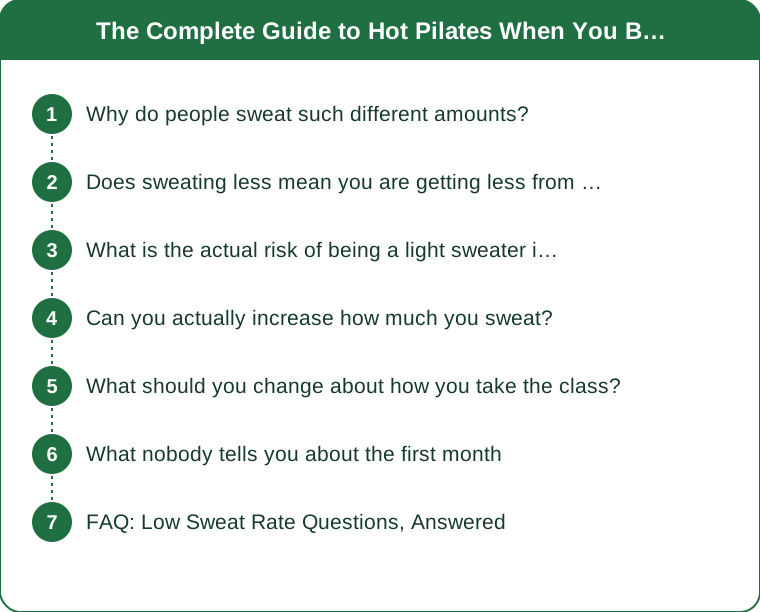
Why do people sweat such different amounts?
Sweat rate varies more between individuals than almost any other physiological measure in exercise. Ranges from roughly 0.5 to 2.5 liters per hour are all documented in healthy people doing comparable work.
Four factors account for most of the variation.
Heat acclimatization status. This is the largest modifiable factor and it works in a direction most people find surprising. Well acclimatized people sweat more, not less, and they start sweating earlier at a lower core temperature. If you sweat little, one plausible explanation is that you are less heat-adapted than the people around you, and that is a training state, not a fixed trait.
Body size and surface area. Larger bodies produce more metabolic heat and have more surface to sweat from. A smaller person doing identical work sweats less in absolute terms and is not under-performing.
Fitness level. Fitter people generally sweat more and earlier, because trained thermoregulation is more responsive.
Individual sweat gland density and output. Genuinely variable between people, largely fixed, and it is nobody’s fault. Some people are simply built with a lower ceiling.
The thing to take away: sweat volume measures your cooling system’s output, not your workout’s input.
Does sweating less mean you are getting less from the class?
No, and the reasoning is worth being clear about because the belief is so persistent.
Sweat is a cooling mechanism. It is your body’s response to rising core temperature. The work you did is measured by force production, muscular tension, and metabolic demand. None of those are read off your towel.
Two people doing identical work can produce identical metabolic heat and dissipate it very differently. One sweats heavily and cools efficiently. One sweats lightly and relies more on skin blood flow and radiant loss.
The strength, control, and endurance adaptations from hot Pilates come from the movement, not from the fluid loss.
Where the belief comes from: the calorie and detox framing common in hot fitness marketing, which treats visible sweat as evidence of effort. It is not, and the fluid you lose is water and electrolytes, replaced within hours, not fat.
One legitimate caveat: because sweating is how you cool, sweating less means you cool less efficiently, which has real consequences in a hot room. That is the part worth acting on, and it is the opposite of the concern most people have.
What is the actual risk of being a light sweater in a hot room?
Your core temperature climbs faster and comes down more slowly, and you may get less warning.
In a 35 to 40 degree Celsius studio, evaporative cooling is doing most of the work of keeping you at a safe temperature. If your evaporative capacity is lower, more heat accumulates.
Practically, this means light sweaters should watch for the signals that are not sweat-related:
- Skin that feels hot and dry rather than damp
- A headache building during the second half of class
- Feeling suddenly cold or getting chills in a hot room, which is a genuine warning sign
- Nausea, dizziness, or a sense that the room is far away
- Heart rate climbing much higher than the effort seems to justify
The chills sign is the one to know. Feeling cold in a hot room can indicate that thermoregulation is failing, and it warrants stopping immediately, leaving the room, and cooling down. It is not something to push through.
A second consideration: light sweaters often drink less during class because they feel less depleted, which is reasonable. But hydration status affects skin blood flow and cardiovascular strain regardless of sweat volume, so drinking to a schedule rather than to thirst is worth doing in a hot room even if your towel stays dry.
This is general information, not medical advice. If you regularly feel unwell in heat, or have a condition affecting sweating such as certain autoimmune conditions, diabetes-related neuropathy, or take anticholinergic medications, discuss hot classes with your doctor.
Can you actually increase how much you sweat?
Yes, partly, and the mechanism is heat acclimatization.
Repeated heat exposure produces a consistent set of adaptations over 7 to 14 days: you begin sweating at a lower core temperature, you sweat more in total, and your sweat contains less sodium. Plasma volume expands, which improves cardiovascular stability in heat.
What this means for a hot Pilates practice: if you attend once every two weeks, you are never acclimatizing. If you attend three times a week for two weeks, you very likely will, and one visible sign is that you start sweating earlier in class than you used to.
A realistic protocol:
- Weeks 1 to 2: 3 sessions per week, and expect them to feel harder than the schedule suggests. Take the back row, which is usually cooler. Leave the room if you need to; this is normal and not a failure.
- Weeks 3 to 4: the same 3 sessions per week should feel noticeably more manageable. Most people notice earlier sweat onset around here.
- Ongoing: 2 to 3 sessions per week maintains it. Drop below that for more than about two weeks and it starts to fade.
What will not increase your sweat rate: drinking more water immediately before class, wearing more clothing, or working harder within a single session. The first does not change gland output, the second reduces evaporation and therefore cooling, and the third raises heat production without improving heat loss.
Ceiling caveat: acclimatization moves you within your own range. If your baseline gland density is genuinely low, you will sweat more than you used to and probably still less than the person next to you. That is fine.
What should you change about how you take the class?
Six adjustments, most of which are the opposite of what light sweaters typically do.
Position yourself where air moves. Near a fan, near the door, in the back row. Air movement is what makes evaporation work, and if you produce less sweat, you want every bit of it to evaporate rather than sit on your skin.
Wear less, and wear fabric that does not hold moisture. A light sweater wearing a long-sleeve top is trapping the small amount of cooling they have available. Minimal, thin, and loose-adjacent beats fitted and layered.
Drink on a schedule, not by feel. Something like a few sips every 10 to 15 minutes. You will feel less need than the people around you, and your need is not proportionally lower.
Do not chase sweat by increasing intensity. Working harder produces more heat without improving your ability to shed it, which is exactly the wrong direction in a hot room.
Take the cool-down seriously. Light sweaters cool more slowly after class. Do not go straight into a hot shower. Give yourself 10 minutes in a cooler space, and if you are still flushed 20 minutes later, that is information about how much heat you accumulated.
Reconsider whether the heat is what you want at all. This is worth saying plainly: if you enjoy the movement and the heat consistently makes you feel unwell, non-heated Pilates delivers the strength and control benefits without the thermal load. The heat is a feature of the format, not a requirement of the method.
Seasonal note: studios often run warmer in fall and winter, and you will arrive cooler from outside, which makes the contrast sharper. If you acclimatized over the summer, that adaptation fades within 2 to 4 weeks of the weather cooling, so expect the first few classes after the seasonal turn to feel harder than they did in August. That is a fading adaptation, not a fitness loss.
What nobody tells you about the first month
The people you are comparing yourself to have usually been doing this for months, and that is most of the difference you are seeing.
A regular attendee is fully heat-acclimatized. They begin sweating within the first few minutes because their threshold has dropped. A newcomer starts sweating much later, if at all, in the same class.
So the puddle on the next mat is often not a difference in effort or in fitness. It is a difference in weeks of exposure.
There are two more things people rarely mention about the first month.
Your rating of the class difficulty will be systematically wrong. In an unacclimatized state, heart rate at a given workload runs 10 to 20 beats higher, and perceived exertion tracks that. So the class feels harder than the movement warrants, and people conclude they are unfit. Four weeks later the same class feels moderate. Nothing about your strength changed in that window; your thermoregulation did.
The soreness pattern is different from what you expect. People assume a hot class produces less soreness because the muscles are warm. In practice, the heat lets you reach ranges you have not loaded before, which produces more soreness in weeks one and two, not less. This is normal and it settles.
A reasonable way to judge whether the format suits you: give it six sessions across three weeks before deciding anything. That is roughly the acclimatization window. Judging hot Pilates on your first class is like judging running on your first mile.
FAQ: Low Sweat Rate Questions, Answered
Why do I sweat so much less than everyone else in hot Pilates?
Most often because you are less heat-acclimatized than the regulars, who have lowered their sweat onset threshold over weeks of exposure. Body size, fitness, and individual gland density account for the rest.
Does sweating less mean I burned fewer calories?
No. Sweat measures cooling, not work. Calorie expenditure comes from the muscular and metabolic demand of the movement, which is unrelated to how much you visibly perspire.
Should I stop going to hot classes if I barely sweat?
Not necessarily, but pay closer attention to overheating signs, since you cool less efficiently. If the heat consistently makes you feel unwell, non-heated Pilates gives the same movement benefits without the thermal load.
TL;DR:
- Sweat rate varies by a factor of three between healthy people, driven mostly by heat acclimatization, body size, fitness, and gland density.
- Sweating less does not mean working less. Sweat measures cooling output, not training input.
- It does mean you cool less efficiently, so watch for hot dry skin, headache, chills in a hot room, and disproportionate heart rate.
- Acclimatization over 2 to 4 weeks at 3 sessions per week will increase your sweat rate within your own range.
- Sit near moving air, wear less, drink on a schedule, and do not chase sweat by working harder.
The puddle on the next mat is a record of somebody else’s weeks of exposure, not a scoreboard for your class.
See It in Motion
Seen here: High Waist Printed Bootcut Yoga Pants with Pockets — shop it on bubblelime.com
Keep Reading
This article is for general informational and styling purposes only. Fit, sizing, and product availability may vary.