The Complete Guide to Your First Three Months of Hot Pilates
Quick Answer: Heat adaptation takes about two weeks, muscular adaptation about six, and the two most common quit points are week three (when novelty ends and soreness peaks) and week eight (when visible progress plateaus). Plan for two to three classes a week, expect the first four classes to be genuinely unpleasant, and judge results at twelve weeks rather than at four.
The first class is memorable in a way that is not entirely positive. The room is hotter than you expected, the pace is faster than you expected, and somewhere around minute twenty-five you have a fairly clear conversation with yourself about leaving.
Most people who quit hot pilates do so in one of two specific windows, for two specific and predictable reasons.
Here is what the full three months actually looks like, so neither of them takes you by surprise.

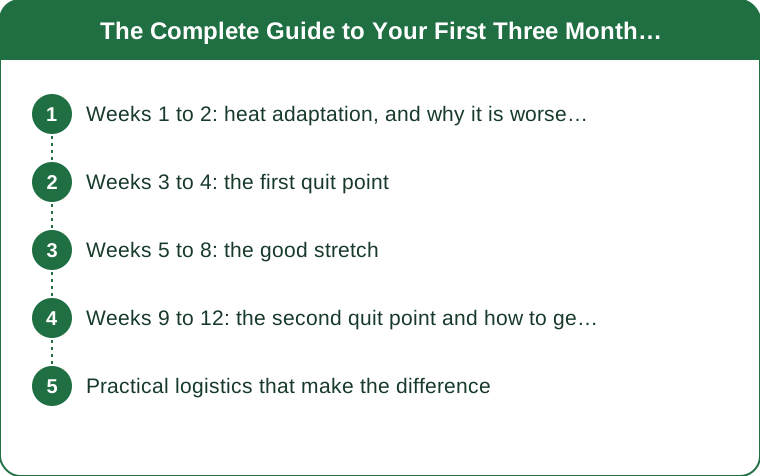
Weeks 1 to 2: heat adaptation, and why it is worse than the exercise
The dominant experience of your first two weeks has almost nothing to do with pilates. It is thermoregulation.
Hot pilates studios typically run 90 to 105°F, sometimes with added humidity. Your body has a well-characterized adaptation response to that, and it takes roughly 10 to 14 days of repeated exposure:
- Plasma volume expands by 5 to 10%, giving you more circulating fluid to work with
- Sweat onset happens earlier in the session, so cooling starts before you overheat
- Sweat becomes more dilute, conserving sodium
- Heart rate at any given effort drops meaningfully
Before that adaptation, you are doing a moderately hard workout with a cooling system that is not configured for the room. That mismatch — not weak core strength — is why the first classes feel disproportionately awful.
What to do in weeks 1 to 2:
Go two to three times a week, not once. Adaptation is driven by frequency of exposure, and once a week does not produce it — which is why people who go weekly report that it never gets easier, while people who go three times a week report it getting easier by class five.
Hydrate the day before, not just the hour before. Meaningful hydration is a 24-hour project; drinking a liter in the parking lot mostly makes you uncomfortable.
Add electrolytes, particularly sodium. You lose a substantial amount in a hot class and replacing water alone can leave you feeling worse afterward, not better.
Take the child’s pose. Sitting out 90 seconds and returning is how you complete the class; pushing through dizziness is how you end up leaving early or not coming back. Every experienced person in the room does this.
Position yourself away from the heaters for the first several classes, usually the back or the sides near the door.
Weeks 3 to 4: the first quit point
This is where most dropouts happen, and the reason is a specific and unlucky collision.
By week three, the novelty has worn off — you know what the class is, it is no longer an adventure, and the initial motivation spike has decayed. At the same time, you are now working hard enough to generate real muscular fatigue rather than just being overwhelmed by heat, so soreness is peaking. And visible results have not arrived, because three weeks is genuinely too early for them.
High cost, no visible return, no novelty. That is the exact profile of a habit that dies.
What gets people through it:
Change the metric. Stop evaluating on how you look and start evaluating on something that is already improving. How many times did you take a break this class versus your first? Can you hold the plank sequence through to the end? Did the last ten minutes feel survivable? Those numbers are moving right now, and looking at them is the difference between quitting and continuing.
Expect the soreness to be worst in this window. Hot pilates has a lot of high-repetition, small-range work that produces a particular kind of delayed soreness people are not used to. It genuinely diminishes from about week four.
Book classes in advance. The decision to go is much easier when it was made three days ago.
Find one thing you like about it that is not results — a specific instructor, the time slot, the way you feel for the two hours afterward. Habits survive on the immediate reward, not the delayed one.

Weeks 5 to 8: the good stretch
If you get past week four, this is the most rewarding part of the whole block.
Heat adaptation is complete. The room stops being the main character. You now have the attention available to actually notice what your body is doing, which means your form improves quickly in this window — often more in weeks five to eight than in the first four combined.
Muscular endurance changes become apparent. Sequences that required breaks now do not. Core endurance, in particular, improves fast in this phase because hot pilates trains it with high volume and short rest, which is precisely the stimulus endurance responds to.
This is also the window to make two upgrades:
Increase frequency if you have been at two classes a week. Three is the sweet spot for most people — enough stimulus for continued progress, enough recovery to sustain it.
Start paying attention to the parts you avoid. Everyone develops a personal set of movements they quietly do at half effort. Naming yours and working on them is where the next chunk of progress lives.
A note on what hot pilates does and does not build: it is excellent for muscular endurance, core control, mobility, and cardiovascular conditioning. It is not a maximal strength stimulus, and the heat does not burn meaningfully more calories than the same work in a cool room — most of the extra weight lost during a class is fluid that returns within hours. If strength or bone density is a goal, this belongs alongside resistance training, not instead of it.
Weeks 9 to 12: the second quit point and how to get past it
The week-eight-to-ten plateau catches people who made it through everything else.
The mechanism is straightforward: your body has adapted to the class. The same class, at the same intensity, delivered three times a week, was a large stimulus in week one and is a maintenance stimulus by week nine. Progress does not stop because you are doing something wrong; it stops because you did it right.
The options, in rough order of usefulness:
Increase your own effort within the class. Most hot pilates is self-loaded — the range of motion, the tempo, and the control are yours to set. Slowing the eccentric portion of every movement changes the stimulus substantially without changing the class.
Add resistance. Many studios permit light hand weights or bands. A 2 to 3 lb weight in a high-repetition pilates context is a meaningful load change.
Vary instructors deliberately. Different instructors have genuinely different sequencing, and the variation is a stimulus in itself.
Add a complementary modality. Two hot pilates classes plus one resistance training session per week produces better outcomes at this stage than three hot pilates classes, because it adds the stimulus the class does not provide.
And take a deliberate deload. A week at reduced frequency around week ten is not a setback — accumulated fatigue from ten weeks of heat and volume is real, and people frequently report their best classes in the week after backing off.
Judge the block at twelve weeks. That is roughly when body composition changes become genuinely visible, when strength endurance gains are unmistakable, and when you have enough data to know whether this is your thing.
Practical logistics that make the difference
The unglamorous list that determines whether the three months is pleasant or miserable.
Timing food. Nothing substantial within two hours of class. Heat plus core work plus a full stomach is a bad combination and it is behind a lot of first-class nausea. A small carbohydrate snack 60 to 90 minutes before is ideal.
What to wear. Fitted, not loose — loose fabric slides and gets in the way during floor transitions. Synthetic or blend rather than cotton, which holds water and gets heavy. Most people go barefoot; grip socks help on slick floors.
What to bring. A mat towel is close to essential, because a sweaty mat is genuinely dangerous during plank sequences. A second small towel, a water bottle you can refill, and a change of clothes for after.
After class. Cool down gradually rather than stepping into cold air immediately; your blood vessels are dilated and the sudden change causes lightheadedness. Rehydrate with electrolytes over the next few hours, not all at once.
Recovery between classes. Back-to-back days are fine once adapted but hard in weeks one to four. Alternating days is the better default for the first month.
When to skip. Illness with fever, dehydration, hangover, or pregnancy without clearance. Heat stress with any of those is a genuine risk rather than a toughness question.
This is general information, not medical advice. If you are pregnant, have cardiovascular disease, low blood pressure, a condition affecting thermoregulation, or take medication that affects sweating or blood pressure, talk to a clinician before starting hot classes.
TL;DR:
- Weeks 1 to 2 are about heat adaptation, not fitness — go two to three times a week or it never gets easier.
- Week three is the first quit point: novelty gone, soreness peaking, no visible results yet. Change your metric to breaks-taken rather than appearance.
- Weeks 5 to 8 are the payoff window; form and core endurance improve fastest here.
- Weeks 8 to 10 plateau because you adapted. Slow your tempo, add light resistance, vary instructors, or add a resistance session.
- Judge results at twelve weeks, not four.
- Eat nothing substantial for two hours before, wear fitted synthetics, bring a mat towel, and replace sodium as well as water.
See It in Motion
Seen here: Super High Waist Embossed Yoga Leggings with Inner Pocket — shop it on bubblelime.com
Keep Reading
This article is for general informational and styling purposes only. Fit, sizing, and product availability may vary.