The Complete Guide to Choosing Where to Put Your Mat in a Hot Pilates Studio
Quick Answer: Heat rises and airflow is directional, so the back of a studio is usually hotter than the front, spots directly under vents are cooler and drier, and corners are typically the hottest and stillest places in the room. Beginners do best in the back corner nearest the door on their first few visits - not because it is cooler, but because it is the easiest place to sit down or leave without disrupting anyone. After that, choose deliberately based on what you want the class to be.
Same class, same instructor, same week - and it felt dramatically harder than last time.
You were three metres to the left. In a heated room, that is not a small difference.
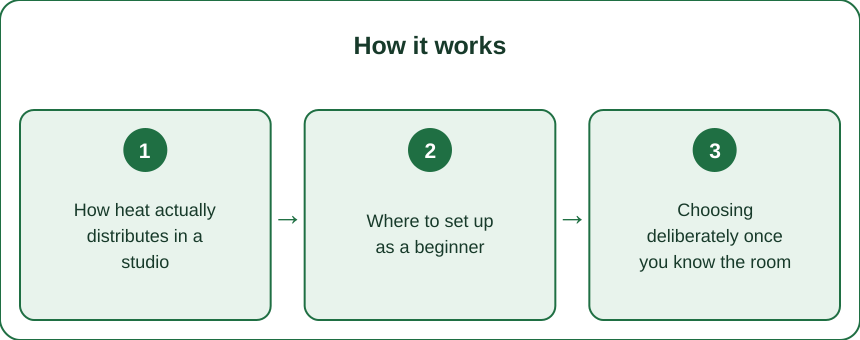
How heat actually distributes in a studio
Heat rises, so the upper part of the room is warmer than floor level, which matters most for standing sequences and least for floor work. Taller people experience a genuinely hotter class in the same room.
The back of the room is usually hotter than the front. Heaters and airflow are typically arranged toward the front where the instructor is, and air movement decreases with distance from the source.
Corners are the hottest and stillest spots in most studios. Air circulates poorly there, so both heat and humidity concentrate - which is why the corner that felt fine in a cooler class feels punishing in a hot one.
Directly under a vent is the coolest and driest position, and it can be too dry - a strong airflow across you the whole class can be as unpleasant as still heat, particularly for eyes and throat.
Near the door is variable rather than cool. It gets a draught each time someone enters or leaves, which means intermittent cool bursts rather than consistent relief.
Humidity varies alongside temperature, and humidity affects perceived heat more than the thermostat number does. A humid corner at 35 degrees feels considerably harder than a well-ventilated spot at the same temperature.
And mirrors and windows change the local conditions too - a spot next to a large window can be several degrees different depending on the season and the time of day, which is why a favourite autumn spot may not be the right summer one.
Where to set up as a beginner
Back corner near the door, for the first three to five classes. The reason is practical rather than thermal: it is where you can sit down, take a break, or leave without anyone noticing.
Being able to leave easily matters more than being cool, because the most common beginner problem is feeling trapped, and the anxiety that produces makes the heat harder to tolerate.
Do not choose the front row to see the instructor better. You can see less from the front than you think, because you cannot see anyone else - and watching other people is how most beginners actually follow a class.
A middle-back position lets you see several people around you, which is genuinely useful for a format where you may not know the movements yet.
Tell the instructor it is your first hot class. They will usually suggest a spot, and they will keep an eye on you, which is worth more than any positioning strategy.
Give yourself space on both sides if the class is not full. Bodies radiate heat, and a packed row is meaningfully hotter than a spread one.
And expect to move around for the first month before settling. The spot that suits you depends on how you respond to heat, which you do not know yet - trying three or four positions is the fastest way to find out.
Choosing deliberately once you know the room
If you want the class harder, go to a back corner. More heat, less airflow, higher humidity - it is the most demanding position in most studios and it is a legitimate way to progress without changing the class.
If you want it more manageable, find the airflow. Near a vent or a fan, in the front third, away from corners. This is the right choice on low-sleep days, when returning after a break, or during your cycle if the heat hits you harder then.
If you are struggling with dizziness, choose a spot where you can get to the floor easily and where the instructor can see you. Being visible matters when you might need help.
If you are tall, factor in the vertical gradient. Standing sequences put your head in genuinely warmer air, and a slightly cooler position compensates for a difference shorter people in the same room do not experience.
If you sweat heavily, avoid being directly beside someone in a packed class. This is a practical courtesy as much as a comfort choice, and most studios have unspoken norms about it.
If you slip a lot, position away from the highest-humidity zones, since a humid corner makes mat and towel grip noticeably worse.
And revisit the choice seasonally. A studio’s heat distribution changes when the outdoor temperature drops and the building’s own heating comes on - the spot that worked all summer may behave differently in a few weeks.
The setup details that matter as much as position
Bring a full-length towel and use it, not just a hand towel. Grip failure is the most common practical problem in hot classes, and it correlates strongly with position humidity.
A second small towel for hands and face is worth it. Wiping with the same towel you are gripping defeats the purpose within twenty minutes.
Set your water within reach without leaving the mat. Reaching across a neighbour mid-class is disruptive and it discourages you from drinking, which is the wrong outcome.
Arrive early enough to acclimatise for five to ten minutes in the room before class starts. Walking straight in as the class begins makes the first ten minutes considerably harder.
Lie down during that acclimatisation rather than sitting or standing - it lets your body adjust in the coolest air in the room before you are asked to do anything.
Check the mat surface for your specific grip needs. Some studios have very smooth floors where a mat slides, and a corner position with high humidity compounds that.
And note your spot after a good class. People remember the bad classes and not the position they were in, which is why so many people never work out that their experience varies systematically with where they set up.
How a full class changes everything about your choice
Class size changes the room more than the thermostat does. Thirty bodies radiate heat and add moisture continuously, so a full class is meaningfully hotter and considerably more humid than a half-empty one at the same setting.
The effect is not evenly distributed. In a packed class, the middle of the room becomes the hottest zone because you are surrounded on all sides, which reverses the usual back-corner rule.
Your neighbours matter individually. Being directly beside someone who runs hot, or between two people in a tightly packed row, adds a real amount of radiant heat that you would not get with a metre of space either side.
Space also determines whether you can rest. In a packed class it is genuinely harder to drop into child’s pose without contacting someone, and that friction discourages people from resting when they should.
Popular class times are consistently fuller, so the same class on a Tuesday at six is a different experience from the same class on a Thursday at two. If a class has been feeling unmanageable, check whether you have been going to the busiest slot.
Arriving early matters more in a full class, because it is the only way you get a choice at all. In a packed studio the late arrivals take whatever remains, which is usually the middle or a corner.
Consider switching to a quieter time rather than pushing through, particularly while you are building heat tolerance. A less crowded class at the same temperature is a genuinely easier session, and it is the simplest adjustment available.
And if you are stuck in the middle of a full room, prioritise resting early and getting low - the two strategies that work regardless of where you ended up. The middle of a packed studio is the position where taking a break before you need one matters most.
As autumn classes fill up with people moving indoors for the season, expect studios to be busier than they were through the summer, and expect the room to behave accordingly.
Myth vs Fact: Studio Positioning
Myth: The back row is the easy option. Fact: the back is usually the hottest part of the room, and back corners are the hottest and stillest of all. The back is easier socially, not thermally.
Myth: The front row is hardest. Fact: the front is often nearer to airflow and better ventilated. It is more exposed and more visible, which is a different kind of difficulty.
Myth: Studios are heated evenly. Fact: no room is. Heat rises, airflow is directional, and corners circulate poorly - differences of several degrees across a room are normal.
Myth: Under the vent is the best spot. Fact: it is the coolest and driest, and constant airflow across you can be genuinely uncomfortable for eyes and throat over a full class.
Myth: Where you stand does not matter much. Fact: temperature, humidity, and airflow together change perceived effort substantially, and it explains a lot of the class-to-class variation people attribute to their own condition.
Myth: You should find your spot and always use it. Fact: choose by what you need that day, and revisit the choice seasonally as the building’s heating changes the room’s distribution.
FAQ: Hot Pilates Mat Placement, Answered
Where should I put my mat for my first hot pilates class?
Back corner near the door. The reason is practical - you can sit down, rest, or leave without disrupting anyone, which reduces the trapped feeling that makes heat harder to tolerate.
Is the back of the room cooler?
No, usually hotter. Heat rises and airflow is generally directed toward the front, so the back and especially back corners are the warmest, stillest parts of most studios.
Where is the coolest spot?
Directly under or near a vent, usually in the front third. Be aware that constant airflow can be drying for eyes and throat across a full class.
Does it really make that much difference?
Yes. Several degrees plus a humidity difference is enough to change perceived effort noticeably, and it explains much of the variation people blame on their own fitness or sleep.
What if I feel dizzy?
Choose a spot where you can get to the floor easily and where the instructor can see you, and tell them beforehand. Sitting or lying down mid-class is normal and expected.
Does being tall change anything?
Yes. Heat rises, so during standing sequences your head is in warmer air than a shorter person’s in the same room. A slightly cooler position compensates.
Should I always use the same spot?
Choose by what you need each day - harder in a back corner, more manageable near airflow. And revisit it seasonally, since a building’s own heating changes how the room distributes heat.
TL;DR:
- Studios are not evenly heated - heat rises, airflow is directional, and corners are the hottest and stillest spots.
- Beginners should take a back corner near the door for practical reasons, not thermal ones: easy to rest or leave.
- Choose a back corner deliberately when you want a harder class, and find airflow when you want a manageable one.
- Tall people experience a genuinely hotter class during standing sequences because of the vertical gradient.
- Arrive early and lie down for five to ten minutes to acclimatise before class starts.
Revisit your spot seasonally - a building’s own heating changes how the room distributes heat.
See It in Motion
Seen here: High Waist Printed Bootcut Yoga Pants with Pockets — shop it on bubblelime.com
Keep Reading
This article is for general informational and styling purposes only. Fit, sizing, and product availability may vary.