Why Hot Pilates Results Plateau After a Few Months — and the Complete Guide to Breaking Through
Quick Answer: Early hot pilates gains come largely from adaptation to a completely new movement stimulus and improved body awareness — both of which have a natural ceiling. Breaking a plateau usually requires varying spring tension, class format, or add-on strength work, not just attending more classes at the same intensity.
The first two months of hot pilates felt transformative — visible changes, strength gains, a body that moved differently. Then it leveled off, and the same class that used to feel like real progress now just feels like maintenance. This is the honest, complete explanation of why that happens and what to actually do about it.


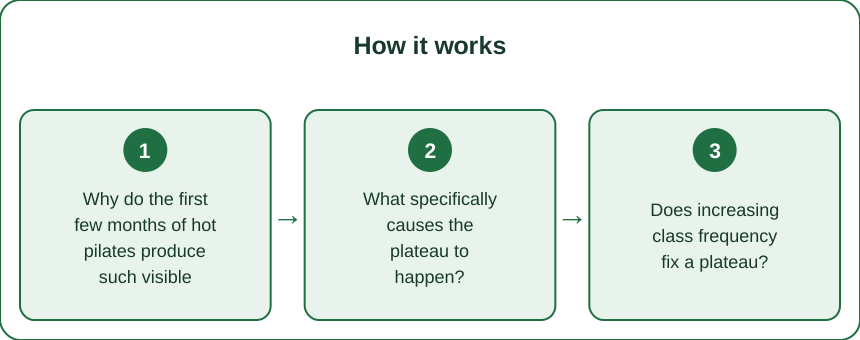
Why do the first few months of hot pilates produce such visible results?
Pilates on a reformer or in a hot studio format introduces a genuinely novel stimulus for most newcomers — small stabilizer muscles, unfamiliar ranges of motion, and heat-amplified intensity all combine to produce fast neuromuscular adaptation. Your body responds quickly to new demands it’s never faced before, which is why early progress often outpaces almost any other format. This isn’t unique to pilates — it’s the standard ‘newbie gains’ pattern seen across nearly every new training modality, just compressed and amplified by the heat and format’s novelty.
What specifically causes the plateau to happen?
Once your stabilizer muscles and movement patterns adapt to the standard class format, the same spring tension and same sequence of exercises stop providing a new stimulus. Your body has essentially solved the puzzle the class was presenting, and without a new variable, there’s nothing left to force further adaptation — this is true of any consistent, unchanging training stimulus, not a flaw specific to pilates.
Does increasing class frequency fix a plateau?
Rarely, and it can backfire. Adding more sessions of an identical stimulus mostly adds recovery demand without adding new adaptation pressure — some people even see results stall further from accumulated fatigue without enough recovery. Frequency alone isn’t the lever that broke the plateau; variety and progressive challenge are.

What actually breaks a hot pilates plateau?
Increasing spring tension deliberately rather than defaulting to the same setting every class is one of the most direct levers — most regular practitioners under-use tension progression compared to how much room most reformers actually have. Varying class format (adding a different instructor’s sequence, a different studio’s style, or occasional non-reformer mat work) reintroduces novelty. Adding external strength training 1-2x per week targets force production in ways pilates’ higher-rep, control-focused format doesn’t fully cover, and the combination often restarts visible progress within a few weeks.
How long does it realistically take to see progress again after making changes?
Most practitioners who add a genuine new variable — higher spring tension, a different class format, or strength training — report noticing renewed progress within 3-6 weeks, roughly matching how long the original adaptation period took. This isn’t instant, but it’s also not another multi-month wait; the body responds to a real new stimulus fairly efficiently once it’s actually different from what it’s adapted to.
What Nobody Tells You About the Hot Pilates Plateau
Here’s what most studios won’t emphasize, because it’s not great for retention messaging: the plateau isn’t a sign you’re doing something wrong, and it isn’t a sign pilates ‘stopped working.’ It’s the completely normal endpoint of any fixed stimulus, and it happens in running, weightlifting, and every other training modality too. The difference is that pilates studios rarely build progression into the standard class the way, say, a structured strength program does — so the plateau shows up and it’s on you to notice and adjust the variables yourself rather than expecting the class format to evolve for you automatically.
FAQ: Hot Pilates Plateau Questions, Answered
Is it normal for a plateau to happen this specifically around the 2-3 month mark?
Yes — this timing lines up closely with typical neuromuscular adaptation windows seen across many training formats, so if your plateau hit around then, it’s a very standard pattern, not something unusual to your body.
Should I switch studios entirely to break a plateau?
Not necessarily — trying a different instructor or occasional different class format at the same studio often provides enough novelty; a full studio switch is one option among several, not a requirement.
Does the heat itself lose its effect over time too?
Somewhat — your body does become more heat-adapted with consistent hot pilates attendance, which is part of why the format feels less intense over time even independent of the strength-related plateau.
TL;DR:
- Early hot pilates gains come from adapting to a genuinely new stimulus, which has a natural ceiling
- More frequency alone rarely breaks a plateau — it’s usually a variety and recovery problem, not an effort problem
- Increasing spring tension, varying format, and adding external strength work are the most direct fixes
- New progress typically shows up within 3-6 weeks of introducing a real new variable, not months
See It in Motion
Seen here: High Waist Bootcut Yoga Pants with Pockets — shop it on bubblelime.com
Keep Reading
This article is for general informational and styling purposes only. Fit, sizing, and product availability may vary.