Why Two Hot Pilates Instructors at the Same Studio Can Run Completely Different Classes
Quick Answer: Hot pilates classes vary significantly between instructors because pacing, cueing style, spring tension recommendations, and how strictly form is corrected are all instructor judgment calls within a shared format — the room and equipment are constant, but the actual training stimulus you get can differ substantially. Learning what each instructor at your studio emphasizes lets you choose classes strategically instead of being surprised by the variation.
You book a hot pilates class expecting the same experience you had last week, and it feels like an entirely different workout under a different instructor. That’s not inconsistency in the format — it’s real variation in how much room instructors have to shape the same core structure.
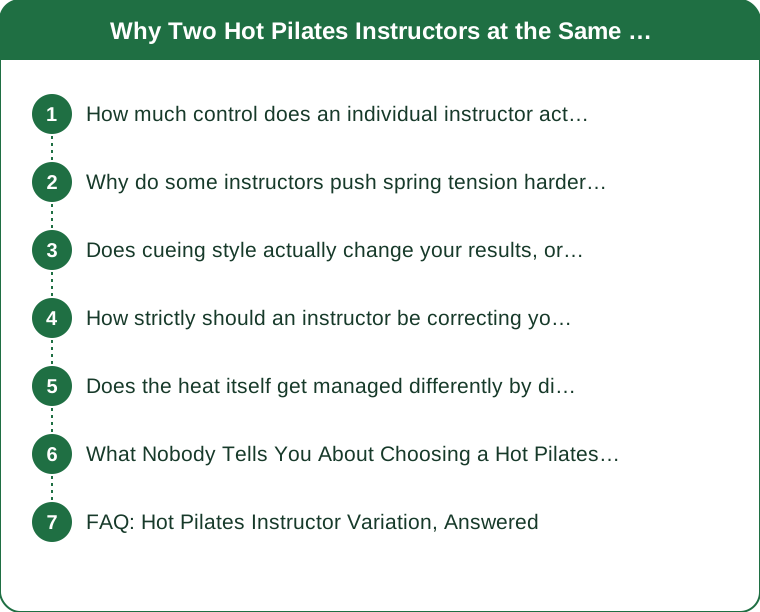
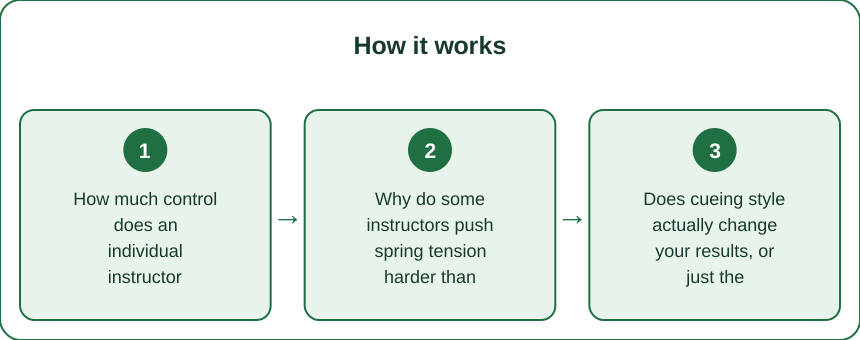
How much control does an individual instructor actually have over class difficulty?
Instructors typically have significant discretion over pacing, rest periods between exercises, and how long each position is held, even within a studio’s standardized class outline. A faster-paced instructor with shorter rest periods can turn the same 50-minute format into a substantially higher cardiovascular demand than a slower-paced instructor working through the identical exercise list.
This means the studio’s class description (‘50-minute full body’) tells you less about actual difficulty than the specific instructor teaching it does, which is why regulars often develop strong preferences for certain teachers over others.
Why do some instructors push spring tension harder than others?
Spring tension recommendations are a judgment call instructors make based on their own training philosophy and how they read the room, and some instructors default to encouraging higher tension for strength focus while others prioritize lower tension with higher rep counts for endurance and control. Neither approach is objectively correct — they produce genuinely different training stimuli even on the identical machine.
If you consistently find one instructor’s classes leave you shakier or more fatigued than another’s at what feels like the same effort level, spring tension philosophy is often the underlying reason, not something wrong with your consistency.
Does cueing style actually change your results, or just the experience?
It changes both — an instructor who cues specific muscle engagement in detail (‘draw your navel to your spine, feel your obliques’) tends to produce more precise, targeted muscle activation than an instructor who cues more generally (‘now let’s move to the next exercise’). Detailed cueing has real value for building mind-muscle connection, especially for people newer to the format, while less detailed cueing can suit people who already have that connection built and want a faster-paced session.
Neither cueing style is inherently better — they serve different purposes depending on where you are in developing your own body awareness within the format.
How strictly should an instructor be correcting your form, and does that vary a lot?
Some instructors walk the room correcting form hands-on or verbally throughout class, while others let students self-correct unless something looks like an injury risk, and this varies based on both instructor style and class size. Hands-on correction accelerates learning proper form significantly for newer students, but can feel intrusive or slow-paced for experienced students who’ve already internalized the movements.
If you’re newer to hot pilates, seeking out instructors known for detailed hands-on correction in your first several classes tends to build a more solid technical foundation than a faster-paced, less corrective class would.
Does the heat itself get managed differently by different instructors?
Yes, somewhat — some instructors adjust pacing around the heat, building in slightly longer breathing pauses during the hottest points of class, while others maintain a constant pace regardless of how the heat is affecting the room. This is partly a safety consideration and partly a stylistic choice, and it affects how sustainable a class feels particularly for people newer to exercising in heat.
If you’ve had a rough experience with dizziness or overheating in hot pilates before, an instructor known for heat-aware pacing is worth specifically seeking out rather than assuming the issue was with the format itself.
What Nobody Tells You About Choosing a Hot Pilates Instructor
Nobody tells you that the ‘best’ instructor isn’t a fixed ranking — it depends entirely on what you’re actually training for that week. A faster-paced, high-tension instructor is the right choice when you want a harder cardiovascular and strength challenge; a slower, detail-focused instructor is the right choice when you’re refining form or coming back from time off.
They also don’t tell you that trying multiple instructors deliberately, rather than sticking to whoever’s schedule happens to fit yours, is one of the fastest ways to figure out what actually challenges your specific weak points, since different instructors will expose different gaps in your strength and control.
FAQ: Hot Pilates Instructor Variation, Answered
Should beginners stick with one instructor or try several?
Trying 2-3 different instructors in your first month gives you a better sense of the format’s range and helps you identify which teaching style actually helps you learn fastest.
Is it normal to have a much harder time with certain instructors even after months of consistent practice?
Yes — this usually reflects a genuine difference in pacing or tension philosophy rather than a decline in your own fitness, especially if it’s consistent with one specific instructor.
How do I find out an instructor’s general style before booking, if the studio doesn’t describe it?
Asking the front desk staff or reading class reviews that mention specific instructor names is often more reliable than the general class description, since the description usually covers the format, not the individual teaching it.
TL;DR:
- Pacing, rest periods, and hold times are largely instructor judgment calls, not fixed by the format itself
- Spring tension philosophy differs by instructor and produces genuinely different training stimuli
- Detailed cueing builds mind-muscle connection faster for beginners; lighter cueing suits experienced students
- Trying multiple instructors deliberately reveals more about your own gaps than sticking to one ever will
The instructor isn’t incidental to a hot pilates class — it’s one of the biggest variables in what you actually get out of it, and once you see it that way, the variation becomes something to use strategically instead of something to be frustrated by.
See It in Motion
Seen here: High Waist 8” Yoga Shorts — shop similar styles on bubblelime.com
Keep Reading
This article is for general informational and styling purposes only. Fit, sizing, and product availability may vary.